
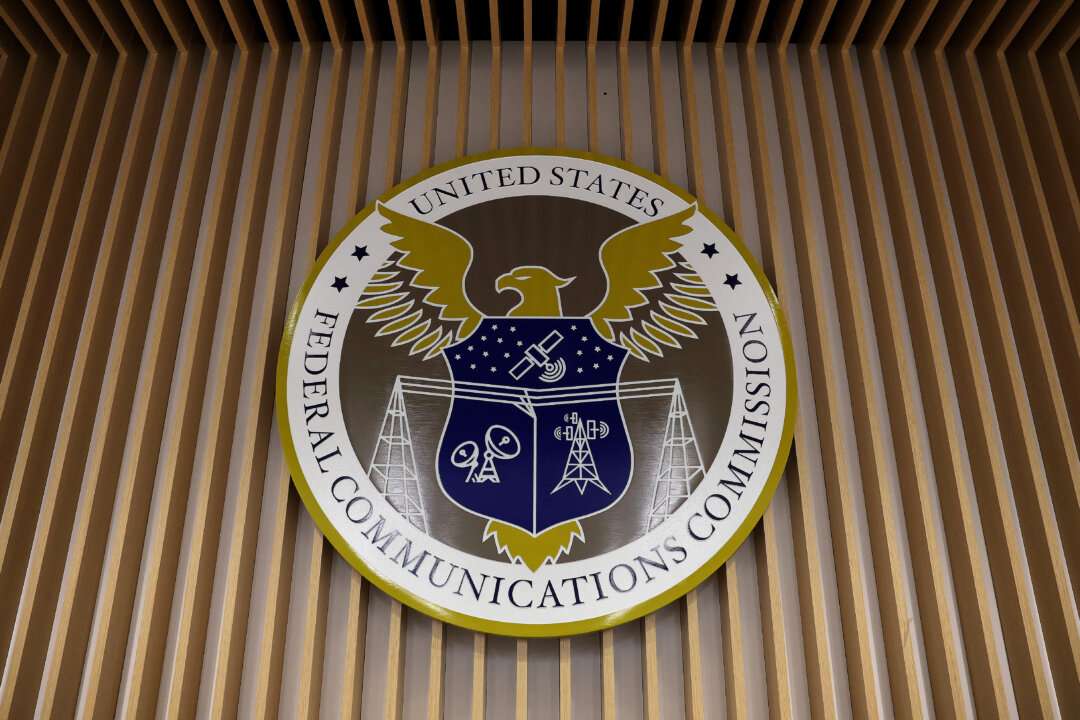
A federal appeals court on Aug. 25 set aside federal guidance that would have let political party committees and joint fundraising committees buy broadcast campaign ads at the steeply discounted rates reserved for candidates, ruling in a case brought by four Democratic candidates 10 weeks before the midterm elections.
The U.S. Court of Appeals for the Fourth Circuit ruled 2-1 that the “lowest unit charge,” or LUC, belongs to candidates alone. Federal law requires broadcasters to sell airtime to legally qualified federal candidates at the station’s lowest rate for the same class and amount of time during the 45 days before a primary and the 60 days before a general election.
The Federal Communications Commission’s Media Bureau issued a public notice on March 30 saying the requirement also applied to authorized committees that fundraise jointly with candidates and to ads that qualify as coordinated expenditures of political parties and candidates. That notice was set to take effect Sept. 4.
“Simply put, the LUC requirement and pertinent campaign finance statutes are clear that neither political parties nor joint fundraising committees with non-candidate members can be entitled to the LUC,” Circuit Judge Robert King wrote for the majority. “In asserting otherwise, the Public Notice is plainly contrary to law and cannot stand.”
The petitioners were Sen. Jon Ossoff (D-Ga.), Rep. Kristen McDonald Rivet (D-Mich.), former Sen. Sherrod Brown of Ohio, and former North Carolina Gov. Roy Cooper, all of whom are on the ballot this fall. They argued the notice diluted their statutory right to buy airtime at the lowest rate by extending that same right to parties and joint fundraising committees, forcing them to answer a higher volume of opposing ads bought at the same price point.
The National Republican Congressional Committee and the National Republican Senatorial Committee (NRSC) intervened in support of the FCC. Both argued, along with the commission, that the court had no jurisdiction to review the notice and that the notice was correct.
The Democratic Senatorial Campaign Committee (DSCC) and the Democratic Congressional Campaign Committee (DCCC) funded the litigation. In a joint statement, DSCC Executive Director Devan Barber and DCCC Executive Director Julie Merz called the outcome a defeat for Republicans.
“The DSCC and the DCCC dealt Republicans a major blow in their latest attempt to rig the rules in their favor,” they said. “Put plainly, today’s ruling makes clear that lowest unit rate is an exclusive right given to candidates and incumbent campaigns and that is the law of the land. Democratic candidates’ strong grassroots fundraising amplifying the voice of everyday Americans remains a fundamental advantage in the midterms, and our stronger candidates and better campaigns will secure us House and Senate majorities in November.”
The NRSC said in an emailed statement it would challenge the decision.
“This was an incorrect ruling that ignores decades of precedent,” said Joanna Rodriguez, the committee’s communications director. “We plan on appealing, and this is the first word not the last.”
The ruling lands on top of the Supreme Court’s June 30 decision in National Republican Senatorial Committee v. FEC, which struck down limits on how much a party committee can spend in coordination with its own candidates.
After that decision, the NRSC told supporters it would shut down its traditional independent expenditure unit and run most of its spending in direct coordination with campaigns, saying coordinated advertising also qualified for the lowest broadcast rates. The Democratic committees disputed that reading at the time and pointed to the pending litigation.
Much of the opinion addressed whether the court could hear the case at all. The FCC argued that no court could review the notice until the full commission ruled on an application for review that the four candidates filed on April 29.
The commission took no action on that application for more than three months, and at oral argument on Aug. 7 an FCC lawyer told the court it was “very unlikely that the Commission will act here before September 4th.” The majority concluded the commission had constructively denied the application and adopted the notice.
A sitting commissioner had already objected to how the guidance was produced. Commissioner Anna Gomez dissented from the Media Bureau’s Aug. 13 order rejecting a separate challenge to the notice from the Television Bureau of Advertising, a broadcasters’ trade group, and released a statement on Aug. 25 saying the discount would channel more “dark money” into the airwaves in the closing weeks of the campaign.
“In the final stretch of a national election, this FCC is unleashing a flood of coordinated campaign money into broadcast advertising, just as the Supreme Court has cleared the way for unlimited coordinated spending between parties and candidates,” Gomez said. “This unprecedented, last-minute decision gives the biggest political spenders an even bigger advantage over everyone else by expanding the candidate-only discount established by law to joint fundraising and party committees, an advantage that will make it hard for anyone else to catch up before Election Day.”
She also claimed the change was made without a public process. “Even more concerning, this decision was made behind closed doors by agency staff, not by the full Commission, and it contradicts what this administration itself told the Supreme Court less than a year ago about who qualifies for this discount,” Gomez said. “In direct conflict with the administration’s position, the FCC relies on alleged staff-level guidance that was never provided in writing and that nobody could find, and adopted it with no opportunity for the public to weigh in.”
Circuit Judge J. Harvie Wilkinson III dissented on both jurisdiction and the merits, writing that the case belonged at the commission and that the majority’s reading of the statute disfavored coordinated speech between candidates and their parties.
“We lack jurisdiction over this case. A staff decision presently awaiting agency review is hardly ‘final.’ That should end our inquiry,” Wilkinson wrote. He added that the decision would “upend settled rules in the middle of an election season,” noting that broadcasters had already extended the discounted rates to party-coordinated ads during this year’s primaries.
Circuit Judge James Wynn joined the majority and wrote separately, arguing that accepting the FCC’s position would let the agency defeat judicial review by delay.
The FCC did not respond to requests for comment by publication time.
We had a problem loading this article. Please enable javascript or use a different browser. If the issue persists, please visit our help center.