
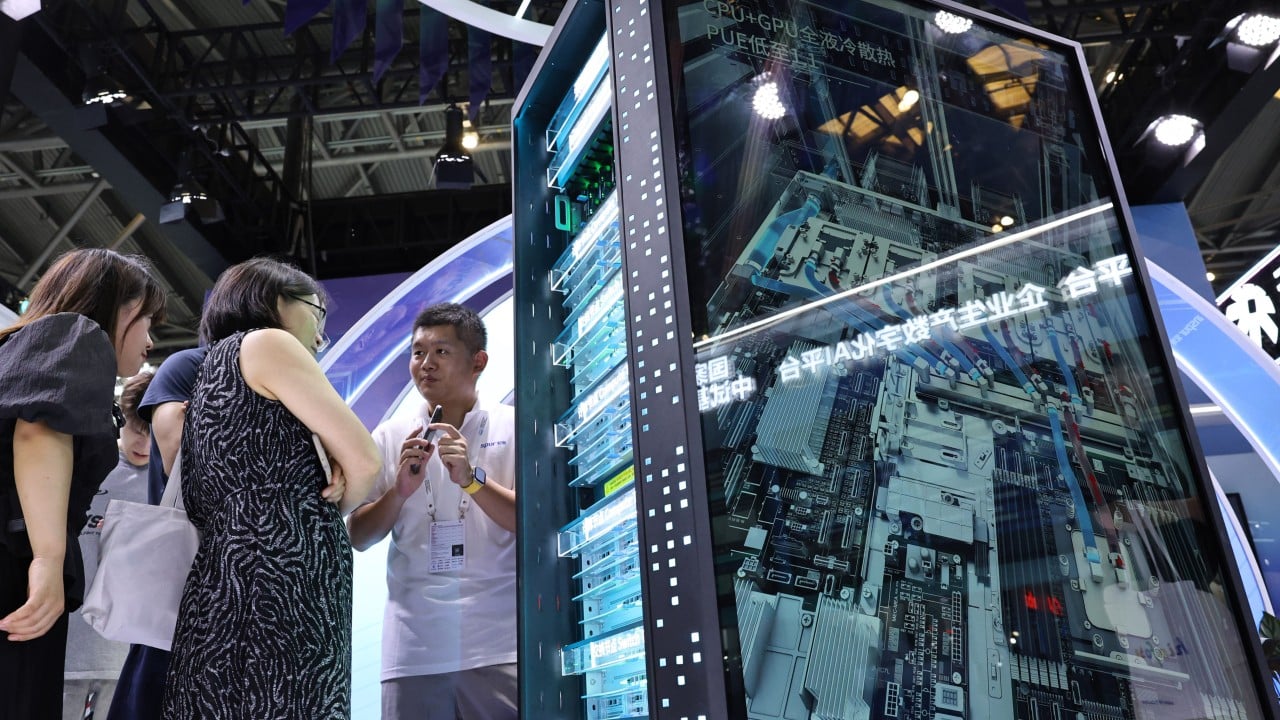
As the size of artificial intelligence models expands beyond 1 trillion parameters, a new concept is dominating the computing landscape: “supernode”.
At this year’s World Artificial Intelligence Conference (WAIC), China’s top AI summit, domestic chipmakers from Huawei Technologies to Biren Technology showcased new hardware designed to knit hundreds or thousands of chips together to act as one giant supercomputer, which they called a supernode.
The focus on supernodes at WAIC reflected a shift in competition across China’s AI computing ecosystem – away from stand-alone chip specifications and towards “interconnects, memory sharing, and system reliability”, Morgan Stanley analysts said in a research note on Tuesday.
But can supernodes immediately address China’s AI computing power bottleneck?
What is a supernode?
“People think putting enough GPUs [graphics processing units] together makes a supernode, which is definitely not the case,” said Chen Daliang, CEO of Suanova, a Shanghai-based AI computing resources provider and a subsidiary of Hong Kong-listed Yeebo Technology.