
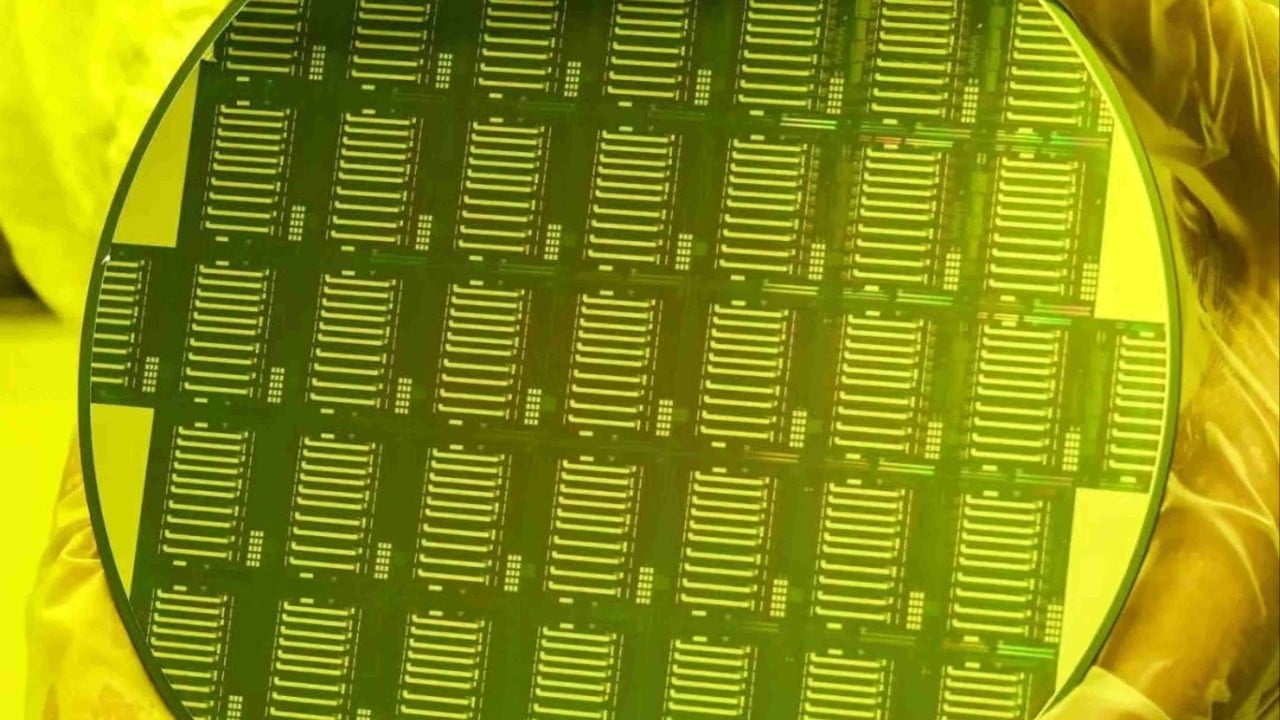
China has established a top-level laboratory in Shanghai dedicated to photonic computing as the country strives to bypass the power constraints and US technology curbs hobbling its ambitions in artificial intelligence development.
The Shanghai Key Laboratory of Integrated Photonic Computing Chips and Systems, launched on Wednesday, was China’s first industry-academia platform dedicated to the field, Shanghai’s Jiefang Daily reported on Thursday.
Zou Weiwen, director of the new laboratory and a photonics professor at Shanghai Jiao Tong University, said photonic – or optical – computing was “an important pathway for achieving breakthroughs in computing power, offering advantages in bandwidth, latency, and energy efficiency”. The new lab is based at the university.
Advertisement
While traditional semiconductors rely on electrons to push data through silicon circuits, photonic chips use light particles – photons – for data transmission and computation.
Because photons travel much faster than electrons and generate less heat, photonic chips could deliver higher performance while consuming just a fraction of the power – making them a potential alternative to the conventional semiconductors used in the power-hungry data centres supporting the AI boom.
Advertisement
The Shanghai lab would focus on research into photonic chip architectures, silicon-photonics integration, optical components and the algorithms and commercial applications needed to make them viable, Jiefang Daily reported.
The launch comes as tech companies around the world race to secure the massive computing power required to train and run increasingly sophisticated AI models. The surging energy consumption and performance demands of the models are pushing conventional silicon semiconductors to their physical limits.