

Microchip development has always been a race to build smaller and smaller transistors – the fundamental components of chip circuits. Now China’s Huawei Technologies wants to change the game entirely.
Faced with US tech export restrictions that block its access to the world’s most advanced chipmaking machinery, Huawei is proposing a fundamental shift in semiconductor progress: stop obsessing over how small the transistors are and start focusing on how fast data moves through the system.
It is a strategy born out of necessity. But how much of an advance is it? And can it rewrite the playbook for China’s tech survival? The South China Morning Post explores all you need to know about the tech giant’s innovation.
What is Huawei’s Tau Scaling Law
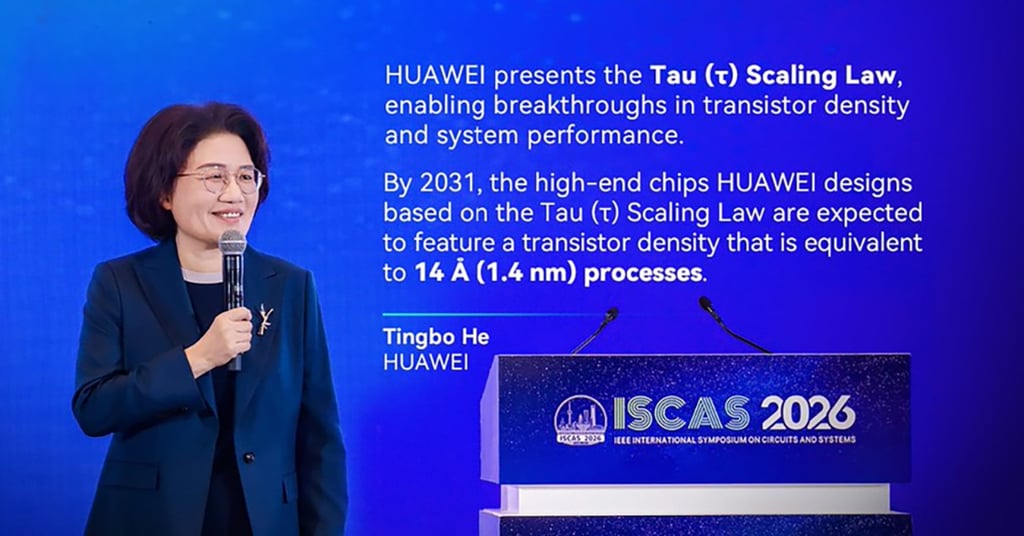
Huawei’s semiconductor chief He Tingbo unveiled a new framework called the Tau, or τ, Scaling Law, at the Institute of Electrical and Electronics Engineers’ International Symposium on Circuits and Systems in Shanghai on Monday.
Advertisement
To understand why this matters, you first have to understand the traditional rule of the tech world: Moore’s Law. For decades, this law dictated that chip progress meant shrinking transistors so you could cram more of them into a given area of silicon, boosting chip performance and cutting costs. The law was named for Intel co-founder Gordon Moore, who first identified that the early semiconductor industry was roughly doubling transistor density every two years.
Huawei’s Tau Law takes a different tack, based on the idea that users do not care about the physical size of transistors; they care how fast computing tasks get done.
In physics, the Greek letter τ represents time constants. This includes delays that occur as data travels across an electronic system – inside transistors, along wires, through memory systems and across chips and data-centre clusters.