
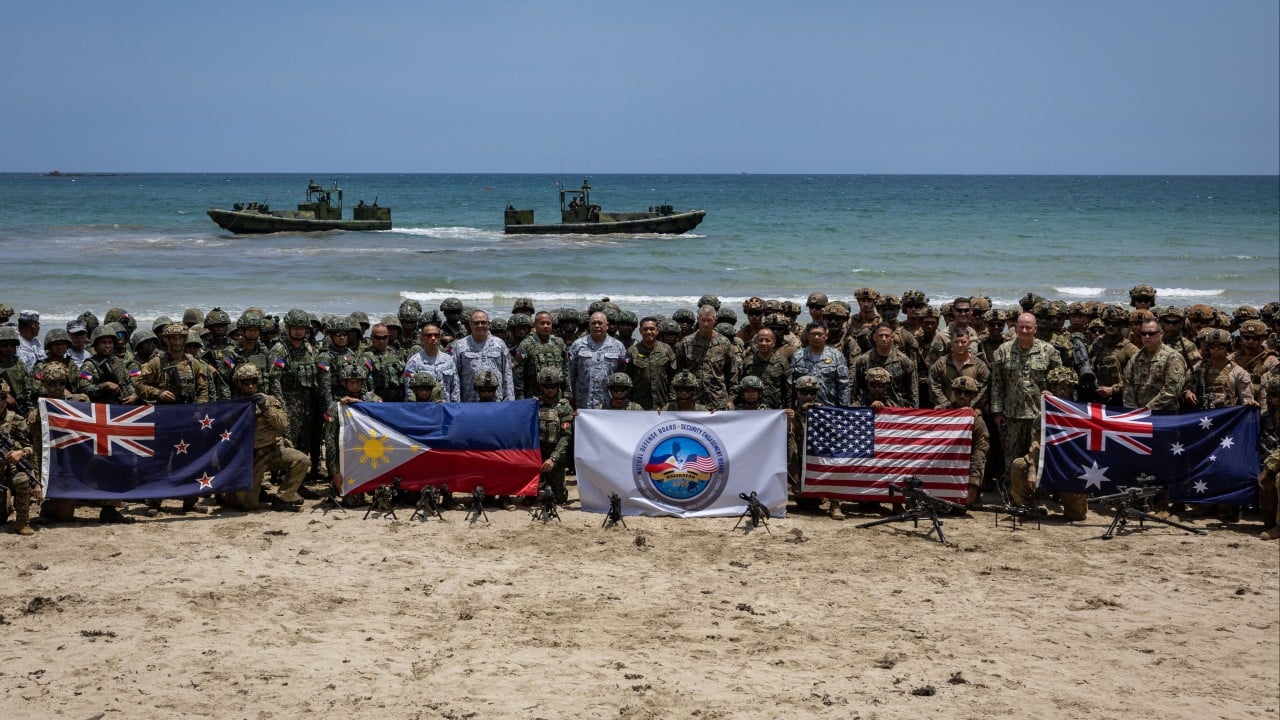
A US and Philippine-led military drill seen as targeting China grew this year into the largest yet, prompting Chinese experts to warn that the annual event will exacerbate regional instability amid heightened tensions in the Indo-Pacific.
The decades-old drill called Balikatan, which means shoulder to shoulder, reached record highs in terms of scale, scope of participation and training complexity this year, according to a report published by the South China Sea Strategic Situation Probing Initiative (SCSPI) this week.
From April 20 to May 8, seven countries – the Philippines, the US, Canada, France, Japan, Australia and New Zealand – sent 17,000 personnel to train along the Philippines’ western sealine, stretching from the South China Sea to the northern Philippine island of Itbayat, just 155km (96 miles) from Taiwan’s main island.
Tensions have run high in the Indo-Pacific in recent years, with increasing incidents occurring between China and the Philippines in the South China Sea.
Advertisement
And relations between Beijing and another participant, Japan, have been further tested, particularly since Japanese Prime Minister Sanae Takaichi suggested in November that a crisis in the Taiwan Strait could justify military intervention, crossing one of Beijing’s red line.
“The scale of the exercise is massive and it is becoming more complex. This is the trend,” said Hu Bo, director of the Beijing-based SCSPI. “It will, for sure, exacerbate regional instability.
Advertisement
“It can’t really change regional balances. But the more drills they conduct, the more responses will be coming from [the People’s Liberation Army].”