
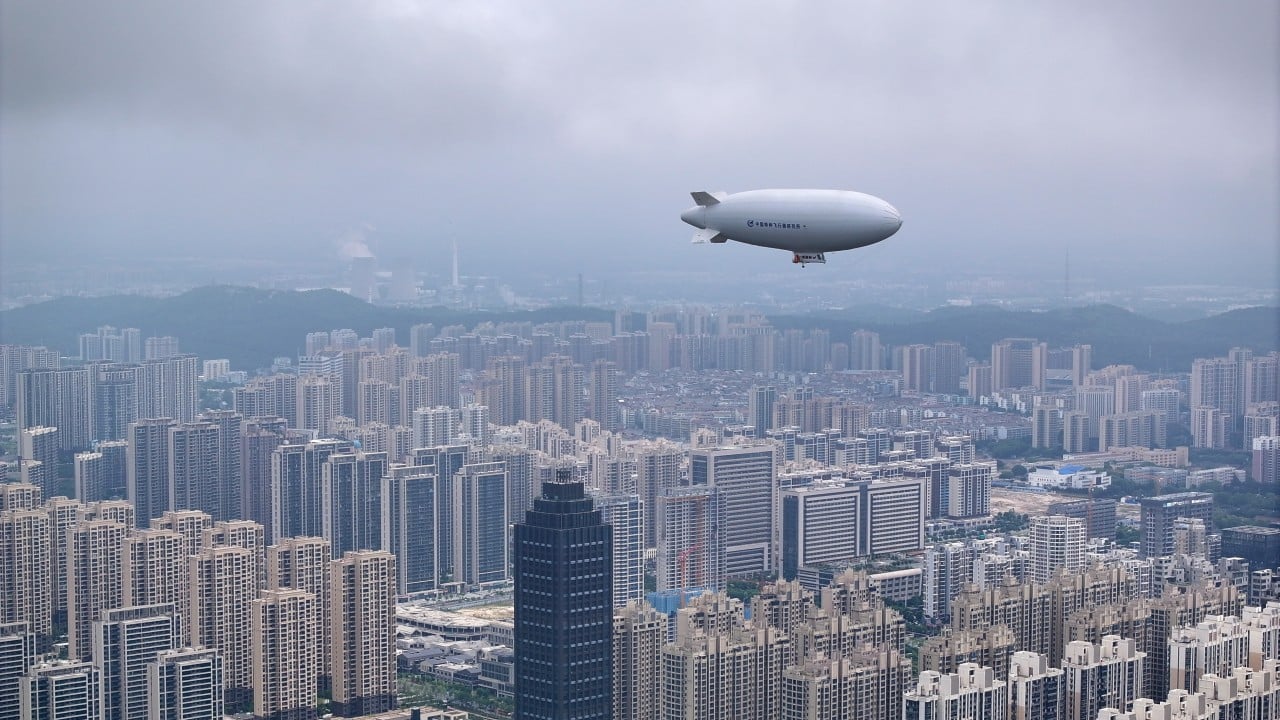
China’s rapidly growing low-altitude economy has reached a new milestone, with the first four domestically trained commercial airship pilots receiving their licenses – a step officials believe could help address a critical talent shortage in the sector.
Issued by the Civil Aviation Administration of China (CAAC), the licenses “signify a breakthrough that addresses the vacuum”, the state-owned Aviation Industry Corporation of China (AVIC) said in a statement this week.
Advertisement
AVIC said the achievement was expected to lay a “solid foundation for the autonomous development of the airship industry and the high-quality growth of the low-altitude economy”, while setting a benchmark for the large-scale cultivation of a professional workforce.
Following a CAAC-approved syllabus, the four pilots completed more than 400 take-off and landing drills using the AS700 Xiangyun, a domestically developed crewed airship.
Developed by AVIC, the AS700 was certified at the end of last year, marking its official entry into mass production, according to Xinhua.
But demand for qualified pilots has become increasingly urgent amid a sector-wide shortage. In a statement, AVIC said the airship had already secured 44 orders. Based on the industry standard of two to three pilots per aircraft, existing orders alone would require about 100 certified pilots – demand which is only expected to rise further as China’s low-altitude economy grows.
Advertisement
Primarily designed for tourism, the airship’s developers are also exploring its potential use in geological surveying and urban security. It could, for instance, be deployed for aerial patrols and traffic monitoring during major events, the state-run Science and Technology Daily reported in late November.