
The release of DeepSeek’s latest large language model, V4, has been followed by a wave of adoption among domestic semiconductor manufacturers and artificial intelligence chipmakers, with firms racing to support the model on local hardware platforms.
The shift comes amid rising geopolitical tensions over advanced semiconductors.
Here are some of the key players enabling the model’s deployment on domestic hardware.
Huawei
Huawei Technologies was among the first to act, with the V4 fully adapted to its Ascend 950PR chip platform. The company said its full line-up of AI processors – including the A2, A3 and 950 series – had completed compatibility, positioning the Ascend 950PR as a primary inference chip.
Advertisement
The optimised model delivers up to 2.87 times the single-card inference performance of Nvidia’s China-specific H20 processor, while improving multimodal generation efficiency by 60 per cent. Deployment costs are reported to be about one-tenth of comparable GPT-based services. Huawei reportedly planned to produce about 750,000 Ascend 950PR chips in 2026, with mass production having started in April and shipments expected in the second half of the year, according to Reuters.
China’s three largest internet groups – Alibaba Group Holding, ByteDance and Tencent Holdings – have collectively placed orders for hundreds of thousands of Ascend 950 processors following the V4 launch, according to the Financial Times.
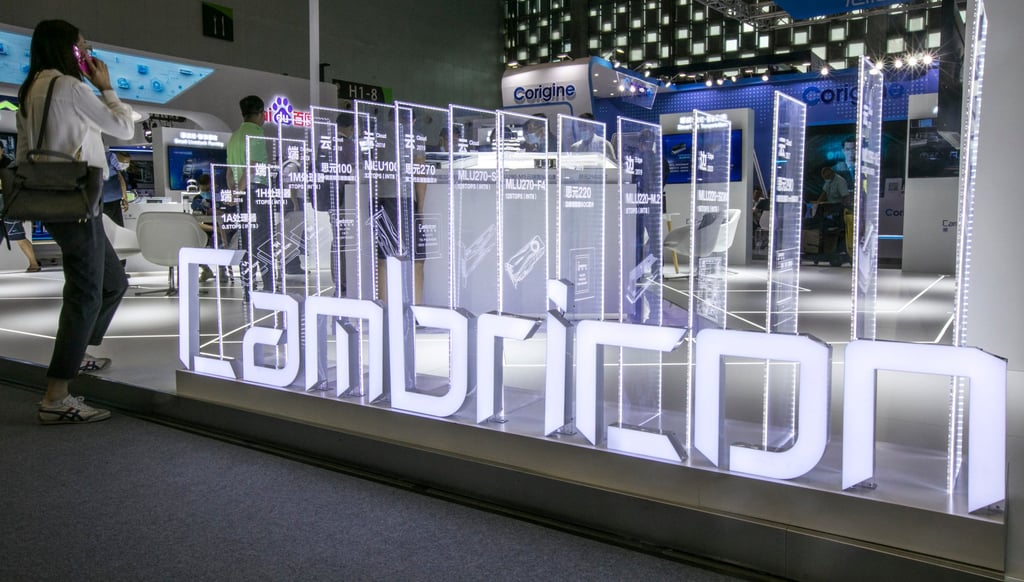
Cambricon
Cambricon Technologies said the V4 achieved full-stack adaptation on the day of release, with deployment code open-sourced simultaneously.