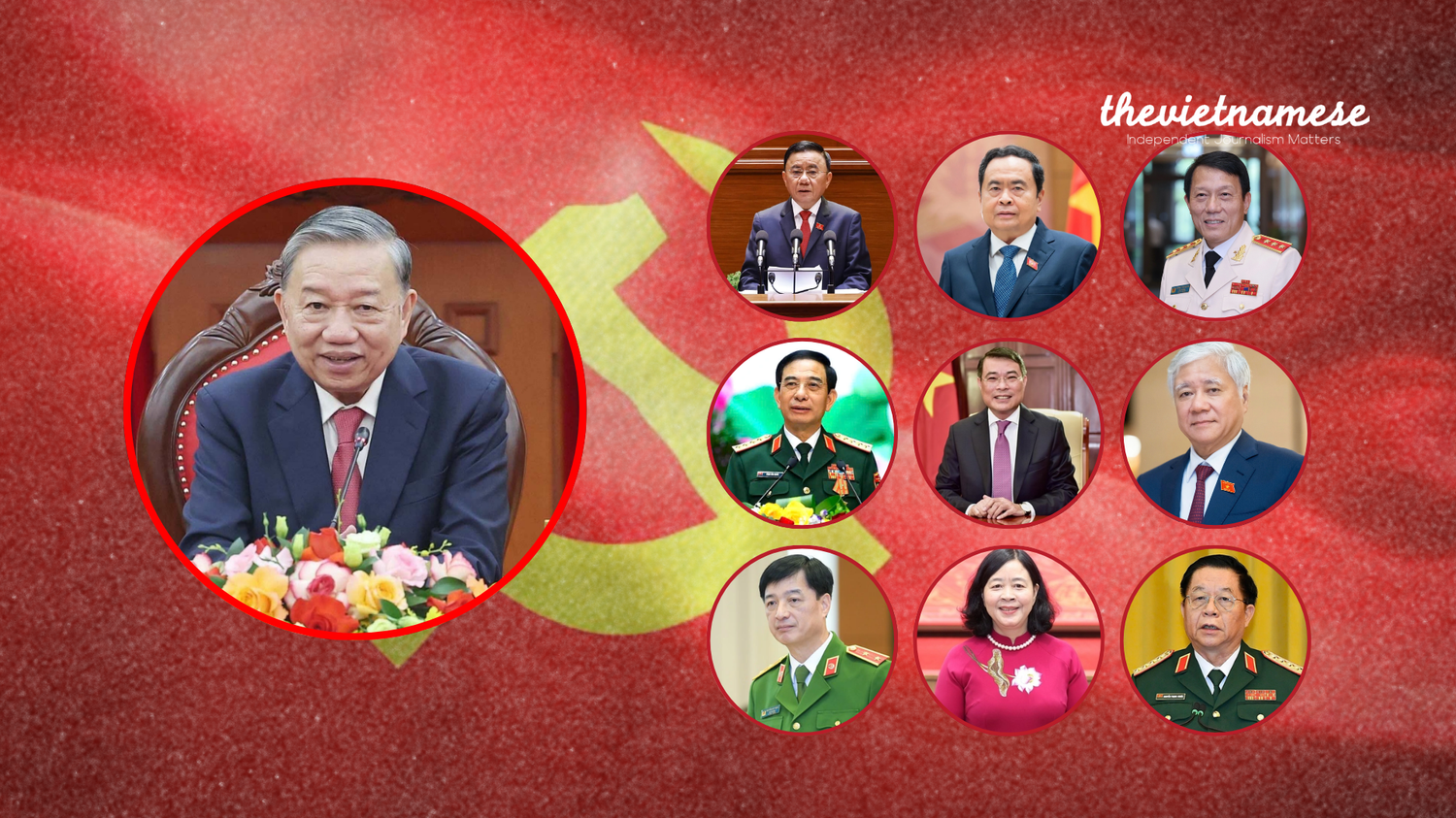
The 14th Party Congress has settled one of its most consequential activities: the election of the new Central Committee of the Communist Party. On the third working day, delegates cast their ballots, resulting in a list of 180 full members and 20 alternate members.
To appreciate the significance of this election, it is necessary to understand what the Central Committee represents. In Việt Nam’s political system, it functions as the “second tier of power,” ranking just below the Politburo. However, it holds the critical authority to elect the Politburo, the Secretariat, and the General Secretary.
Put simply, the Central Committee is the starting line for the nation’s strategic cadres. To enter the Politburo, become General Secretary, or hold key posts such as minister or provincial party secretary, membership in this body is nearly mandatory. Being included on this list means being placed among the candidates for the highest positions in the party and state.
With this power dynamic established, the roster of the 14th-term Central Committee reveals four highly noteworthy features.
General Secretary Tô Lâm Re-elected Despite Exceeding Age Limit
At the top of the 14th-term Central Committee list is “Comrade Tô Lâm.” His inclusion was the most closely watched aspect of the vote count, largely due to the age limits that have governed party personnel since the 8th term. [1]
According to these principles, candidates for the Central Committee should be no more than 55 years old for a first term, 60 for re-election, and 65 for re-election to the Politburo. Yet, he has been re-elected despite exceeding these thresholds.
His re-election can only be understood as a “special case”—the term the Party uses for figures retained despite not meeting criteria regarding age, qualifications, or term limits. [2] This exception, similar to the one made for Nguyễn Phú Trọng in the past, signals that Tô Lâm is highly likely to continue as General Secretary and potentially retain the presidency, as rumored.
Coming from the Ministry of Public Security (MPS), Tô Lâm has been the driving force in expanding that ministry’s influence across the political system. His ongoing presence in the 14th-term Central Committee is a sign that the MPS will continue to consolidate power over the next five years, maintaining the trajectory of the last two years.
The Departure of Phạm Minh Chính and Lương Cường
The retention of Tô Lâm does not imply a blanket exemption for all senior leaders. While the General Secretary was classified as a “special case,” Prime Minister Phạm Minh Chính and President Lương Cường were not re-elected to the 14th-term Central Committee. [3] This selectivity demonstrates that exceptions are rare and carefully calculated amid the reshuffling of power.
For Phạm Minh Chính, this exit represents a safe conclusion to his tenure. He, too, hails from the Ministry of Public Security and is among the few individuals who have weathered an unprecedented period of upheaval, which saw the departure of two general secretaries, four presidents, and four permanent members of the secretariat. While senior positions changed hands at dizzying speed, Chính remained firmly in the prime minister’s seat.
Though he is no longer part of the central power core for the 2026–2031 term, he will remain the sitting prime minister until April 2026, when the 16th National Assembly convenes to select new state leadership.
The case of Lương Cường presents a different narrative. Despite being the only four-star military general among the “four pillars,” his presidency was relatively muted. Despite being head of state, he was frequently overshadowed by Tô Lâm in foreign affairs and major events, rendering his presidency less prominent than even his predecessors. [4]
With Lương Cường’s departure, the balance of power shifts. If Tô Lâm remains the dominant figure, the exit of the military’s top representative raises a critical question: will another military general step into the “four pillars” to maintain the equilibrium between the armed forces and the public security apparatus?
A Larger Military Presence, Police in Key Positions
The 14th-term Central Committee reveals a distinct division of labor between the armed forces.
The military maintains a massive numerical advantage with 26 representatives, a figure that has steadily increased over successive terms. [5] This broad network extends from the Ministry of National Defense down to military regions and corps, reinforcing the army as a foundational pillar of the system.
Its most prominent leader, Minister of National Defense Phan Văn Giang, has been retained as a “special case” despite age limits—a signal that his stability is crucial. He is widely expected to ascend to the “four pillars.” [6]
In contrast, the public security force only has seven representatives. The police force is far smaller, yet every member is a general holding a critical post, from the minister to deputy ministers. This allows them to exert direct influence over internal party management, security oversight, and the administrative system.
Leading this group is Minister of Public Security Lương Tam Quang, a fellow native of Hưng Yên Province like General Secretary Tô Lâm. Under Quang, the Ministry of Public Security has evolved into a “super-ministry” in less than two years, absorbing functions previously managed by other civilian agencies. [7]
The military possesses organizational breadth and continues to play a leading role in government, while public security possesses strategic depth with highly concentrated power and an ever-expanding scope of operations. Yet, both forces share a common trajectory—their political footprint on the Central Committee continues to grow. [8]
Northern Dominance in the Central Committee
Based on the 123 Central Committee members with confirmed backgrounds, the regional distribution reveals a stark imbalance. The North commands an absolute majority with 73 seats, followed by the Central region with 33, and the South trailing significantly with just 17.
This distribution highlights a profound disparity. The South’s representation of 17 members is barely higher than that of a single northern province—Hưng Yên—which boasts 13 members. The fact that one province nearly rivals the political weight of the country’s entire southern region is astonishing.
Meanwhile, the Central region maintains its traditional role as a political “buffer zone,” holding a steady middle ground that is neither dominant nor marginalized.
This structure confirms a fixed pattern in modern Vietnamese politics that has persisted over multiple terms. The North remains the cradle of senior leadership, housing the key institutions for cadre planning, training, and promotion. The South, despite its economic and demographic size, remains politically underrepresented.
This situation is not a new phenomenon but a systemic reality that the 14th Party Congress has firmly reinforced.
***
Beyond these headlines, the 14th-term Central Committee list contains numerous smaller details regarding personnel shifts and structural changes. However, the most critical decisions remain unannounced.
While the Central Committee roster establishes clear trends, the narrative of power for the 2026–2031 term is far from complete. What has emerged so far is merely the framework.
The true nature of the 14th term will only be revealed when the top leadership positions—the “four pillars” and the Politburo—are finally selected in the days and months to come.
Thúc Kháng wrote this article in Vietnamese and published it in Luật Khoa Magazine on Jan. 23, 2026. Đàm Vĩnh Hằng translated it into English for The Vietnamese Magazine.
References:
1. Lê Sáng. (2026, January 23). Tô Lâm tái đắc cử vào Ban Chấp hành Trung ương khóa 14. Luật Khoa tạp chí. https://luatkhoa.com/2026/01/to-lam-tai-dac-cu-vao-ban-chap-hanh-trung-uong-khoa-14/
2. Thúc Kháng. (2026, January 22). Deciphering Việt Nam’s 14th Party Congress: Understanding the “special case” in leadership selection. The Vietnamese Magazine. https://www.thevietnamese.org/2026/01/deciphering-viet-nams-14th-party-congress-understanding-the-special-case-in-leadership-selection/
3. Thạch Hãn. (2026, January 23). Đại hội 14: Thủ tướng Phạm Minh Chính và Chủ tịch nước Lương Cường không có tên trong danh sách đắc cử. Luật Khoa tạp chí. https://luatkhoa.com/2026/01/dai-hoi-14-thu-tuong-pham-minh-chinh-va-chu-tich-nuoc-luong-cuong-khong-co-ten-trong-danh-sach-dac-cu/
4. Annalise Keating. (2025, July 21). Hai lần Tô Lâm lấn sân Lương Cường. Luật Khoa tạp chí. https://luatkhoa.com/2025/01/hai-lan-to-lam-lan-san-luong-cuong/
5. Hoàng Nam. (2026, January 23). Quân đội tăng số ủy viên Trung ương đảng, tổng cộng 26 người. Luật Khoa tạp chí. https://luatkhoa.com/2026/01/quan-doi-tang-so-uy-vien-trung-uong-dang-tong-cong-26-nguoi/
6. BBC News Tiếng Việt. (2026, January 10). Thấy gì khi Đại tướng Phan Văn Giang được giới thiệu ứng cử Quốc hội khóa 16? https://www.bbc.com/vietnamese/articles/czr4n272g3jo
7. BBC News Tiếng Việt. (2026, January 17). Ông Lương Tam Quang: Đại tướng lãnh đạo “siêu bộ.” https://www.bbc.com/vietnamese/articles/cn8j1r587xgo
8. Hoàng Nam. (2026, January 23). Ngành công an có 7 ủy viên Trung ương, tăng đều qua các khóa. Luật Khoa tạp chí. https://luatkhoa.com/2026/01/nganh-cong-an-co-7-uy-vien-trung-uong-tang-deu-qua-cac-khoa/