
Key Events
- State Media Silent as China Opens Commercial Centre on Disputed Hoàng Sa Islands;
- Senior Officials Dominant in Upcoming National Assembly Elections;
- 156 Domestic and Foreign Press Agencies Cleared to Cover Việt Nam’s 14th Party Congress;
- Thanh Hóa Province Resident Charged Over Social Media Posts Targeting Authorities;
Limited Coverage as China Opens Commercial Facility in Disputed Hoàng Sa Islands
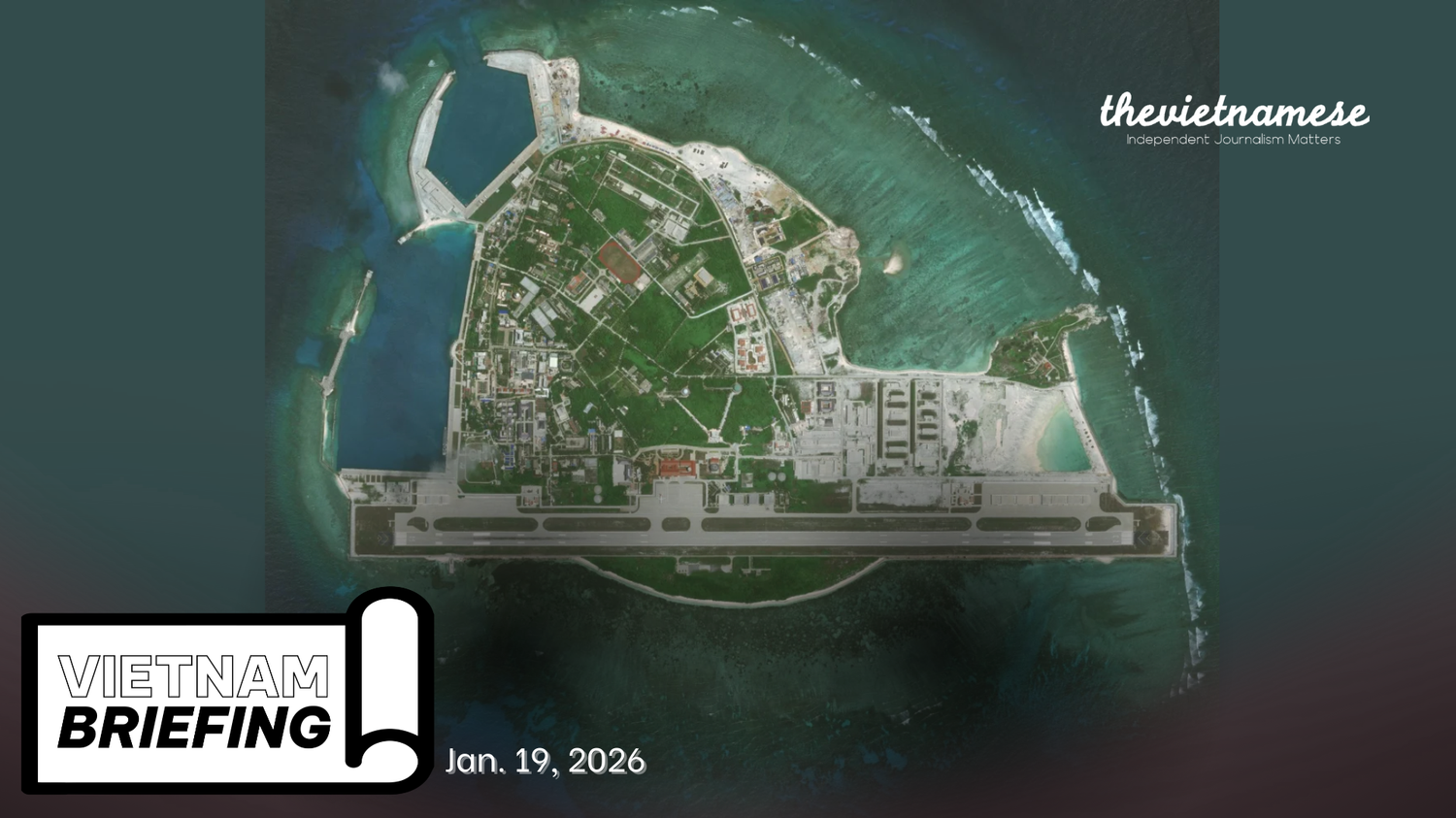
Vietnamese state-run media have remained largely silent amid reports that China has built and opened a commercial center on Phú Lâm Island in the Hoàng Sa (Paracel) archipelago, a territory claimed by Việt Nam but controlled by China. The battle between China and the Republic of Vietnam occurred on January 19, 1974, 52 years ago.
The muted coverage has drawn attention on social media and among observers, highlighting the sensitive handling of territorial disputes in Việt Nam’s domestic information space.
Information about the commercial complex, described by the Chinese media as a shopping and service center catering to residents and visitors, began circulating publicly in late December 2025.
Images and reports shared online suggested the facility was already operational, prompting discussion among Vietnamese netizens and calls for clearer official responses. However, major state newspapers and broadcasters did not prominently report on the development.
The only public response from the Vietnamese authorities came during a regular press briefing by the Ministry of Foreign Affairs on Jan. 8. When asked about China’s activities on Phú Lâm Island, the ministry’s spokesperson reiterated Việt Nam’s longstanding position that all construction and activities carried out without Việt Nam’s permission in the Hoàng Sa archipelago are illegal and have no legal validity.
The spokesperson reaffirmed Việt Nam’s historical and legal sovereignty over the islands under international law, although China was not directly named in the statement.
Hoàng Sa is a group of more than 30 islands, reefs, and shoals in the South China Sea. China has controlled the archipelago since 1974, following a naval confrontation with the Republic of Vietnam. Việt Nam has consistently maintained its sovereignty claims and has repeatedly protested Chinese construction and administrative activities in the area through diplomatic channels.
While international media outlets reported extensively on the opening of the commercial center, domestic coverage in Việt Nam remained minimal. Some state-affiliated outlets only mentioned the issue indirectly by quoting the foreign ministry’s general response, without providing details about the scale or purpose of the Chinese construction. This restrained approach contrasts with more visible coverage in previous cases involving maritime incidents or diplomatic protests.
According to Luật Khoa Magazine, the lack of reporting reflects a broader pattern in which state media avoid detailed coverage of sensitive issues involving China, particularly when such developments could stir public anger or nationalist sentiment.
Analysts note that Việt Nam’s leadership often seeks to strike a balance between asserting sovereignty claims and maintaining stable relations with Beijing, its largest trading partner and an influential regional power.
International observers widely view the construction of civilian infrastructure on Phú Lâm Island as part of China’s long-term strategy to consolidate administrative control over disputed features in the South China Sea. By expanding civilian facilities alongside military installations, Beijing strengthens its de facto presence while framing development as normal economic activity.
As Việt Nam approaches major political events, including the 14th National Party Congress, information management appears especially cautious. The silence of state media at the Hoàng Sa commercial center underscores the limits of public debate on territorial disputes and illustrates how foreign policy sensitivities shape what information is shared with the domestic audience.
Election Without Surprise: Việt Nam’s Ministers Pre-Selected for National Assembly
In the run-up to the 14th National Congress of the Communist Party of Vietnam, scheduled for Jan. 19–25, 2026, a notable political development has unfolded quietly alongside the party’s internal preparations: senior government ministers and top officials are being formally introduced as candidates for the next National Assembly, the 16th legislature (2026–2030).
Though public attention has largely focused on the internal leadership deliberations of the party – where key nominations for Politburo and Central Committee posts are being finalized – another equally consequential process has taken place: multiple ministries and central agencies have organized meetings of their workforce or associated voters to endorse and recommend high-ranking officials as prospective National Assembly deputies.
Under Việt Nam’s political system, the National Assembly is constitutionally the country’s highest representative body and legislative organ, with powers over lawmaking, budget approval, oversight functions, and formal appointments of top state officials. However, the Communist Party’s leadership tightly manages candidate selection and nomination through a multi-stage vetting and endorsement process.
Among those introduced for potential election to the 16th National Assembly are several prominent cabinet members. On Jan. 15, ministries, including Education and Training, Finance, Foreign Affairs, and Home Affairs, held meetings with internal electorates and unanimously supported their respective ministerial heads standing as National Assembly candidates.
Those reportedly included in this group are
- Nguyễn Kim Sơn, minister of education and training;
- Nguyễn Văn Thắng, minister of finance;
- Lê Hoài Trung, minister of foreign affairs;
- Đỗ Thanh Bình, minister of home affairs, among others.
Separate earlier endorsements saw the Ministry of Defense and Ministry of Public Security introduce their senior officers, including General Phan Văn Giang (Minister of Defense) and Minister of Public Security Lương Tam Quang, along with other uniformed officials from those ministries.
In addition, central bodies such as the National Assembly’s own committees and the Office of the National Assembly have conducted meetings to endorse a slate of more than 100 centrally delegated candidates, in line with the official quota and structure outlined by the Standing Committee of the National Assembly.
Việt Nam’s electoral calendar sets the official National Assembly election for March 15, 2026, with multi-tiered nomination and vetting procedures set to conclude throughout January and February.
The nominations made at ministerial and central agency levels are preliminary and will subsequently be considered by higher organs, including the provincial election committees and the National Election Council, before a final list of candidates is confirmed.
Political analysts note that the prominence of sitting ministers among proposed candidates underscores the party’s dual focus on continuity and consolidation of leadership ahead of the Party Congress.
In Việt Nam’s one-party system, where the Communist Party sets the overarching political agenda, this overlap between executive officials and legislative representation is a longstanding feature. However, it also reinforces the central role of party determination in shaping both state and legislative leadership.
The formal introduction of these candidates unfolds against a backdrop of intense internal political preparation for the Party Congress, which will determine key positions on the Politburo and the Central Committee for the next five years. The outcomes of both processes – the National Assembly election and the Party Congress – will significantly influence Việt Nam’s political trajectory through 2031.
The Party Congress is Treated as a Media Event: 156 News Outlets Approved to Cover it
Việt Nam has launched a large-scale media operation to publicize the 14th National Party Congress of the Communist Party of Vietnam, scheduled for Jan. 19–25, 2026, in Hanoi.
According to Luật Khoa Magazine, the government has authorized a total of 156 press agencies from inside and outside the country to report on and disseminate information about the congress, underscoring the party’s emphasis on centralized communication around one of the country’s most important political events.
The media contingent includes 113 domestic press and broadcasting organizations and 43 foreign news agencies. Nearly 600 Vietnamese journalists, editors, and technical staff will be involved, alongside 79 foreign reporters and assistants, including correspondents from overseas Vietnamese media outlets.
This figure marks an increase compared to the 13th Party Congress in 2021, reflecting both expanded domestic mobilization and growing international interest in Việt Nam’s leadership transition.
To support this coverage, authorities inaugurated the Press Centre for the 14th National Party Congress on Jan. 14 at the National Convention Centre in Mỹ Đình, Hanoi. The press center functions as the central hub for accredited journalists, providing working spaces, high-speed internet access, computers, printers, and broadcast facilities.
State media outlets are tasked with producing and distributing official content, including live feeds, photographs, and video materials, which are then shared across the broader media network.
According to official statements cited by Luật Khoa Magazine, primary party and state media—such as Vietnam Television, Voice of Vietnam, Vietnam News Agency, and Nhân Dân (The People) newspaper—will play a leading role in shaping coverage. Other domestic outlets are expected to widely republish and rebroadcast the reporting of the above state media, reinforcing a unified narrative about the proceedings, outcomes, and significance.
The party’s propaganda apparatus oversees the organization of media coverage, issuing directives and guidance on thematic priorities, framing, and tone. Journalists assigned to the congress reportedly received briefings and training in advance, emphasizing the importance of timely, accurate, and consistent reporting that aligns with official messaging.
Coverage is expected to highlight policy directions, leadership decisions, and the Congress’s role in setting Việt Nam’s development agenda for the next five years.
From the authorities’ perspective, the presence of foreign media is portrayed as an opportunity to communicate Việt Nam’s political stability and socio-economic achievements to an international audience. Official sources stress that international reporting can help foster external understanding of the party’s leadership and the country’s long-term strategic goals.
It is also important to note that the highly managed nature of this media mobilization shows how important it is for the state and party to control political information. Despite the large number of participating outlets, access, content, and framing remain tightly regulated, especially during sensitive political moments like party congresses.
As the 14th Party Congress approaches, the coordinated deployment of 156 media organizations highlights how closely communication and political power are intertwined in Việt Nam.
The party congress will not only determine key leadership positions and policy priorities but also serve as a carefully staged media event designed to project unity, continuity, and control to both domestic and international audiences.
Facebooker Lê Minh Vũ is Arrested in Thanh Hóa Province on Charges of Abusing Democratic Freedoms
A resident of Thanh Hóa Province has been arrested and charged under Article 331 of the Penal Code for allegedly abusing democratic freedoms after using social media to criticize local authorities and officials, according to reporting by Luật Khoa Magazine.
This article criminalizes the “abuse of the rights to freedom and democracy” when such actions are deemed to infringe upon the interests of the state or the lawful rights of organizations and individuals.
The case has drawn attention as it combines citizen petitions calling for official accountability with criminal prosecution under a broadly defined national security provision.
On Jan. 14, police in Thanh Hóa announced they had initiated criminal proceedings and ordered the temporary detention of 58-year-old Lê Minh Vũ. The authorities allege that between 2023 and 2025, Vũ repeatedly used his personal Facebook account and a related fan page to post content critical of the Communist Party, state institutions, and local leaders.
According to police statements cited by Luật Khoa Magazine, his posts were said to contain insults, accusations, and unverified claims that allegedly harmed the reputation of officials and negatively affected political security, public order, and social stability.
Notably, some of Vũ’s online activity reportedly involved publicizing petitions and complaints related to perceived shortcomings and misconduct by local authorities.
These posts included calls for disciplinary action against certain leaders and reflections on unresolved grievances at the local level. Investigators, however, characterize such content as hostile and misleading, rather than as lawful expressions of citizen oversight or complaint.
Following his arrest, police searched Vũ’s residence and confiscated documents and electronic materials believed to be connected to the alleged offenses. Authorities are still investigating the case and have not publicly disclosed the specific posts or evidence supporting the charges.
Vũ’s arrest comes amid heightened political sensitivity ahead of Việt Nam’s 14th National Party Congress and upcoming National Assembly elections, periods during which authorities traditionally intensify monitoring of online speech and political expression. Article 331 has frequently been invoked during such times to prosecute bloggers, activists, and social media users who criticize state policies or officials.
Human rights organizations and independent observers have long raised concerns about Article 331, arguing that its vague wording allows for arbitrary enforcement and chills legitimate freedom of expression. They note that activities such as petitioning, criticizing officials, or exposing local governance problems can be reinterpreted as criminal acts when framed as threats to state interests.
State media, meanwhile, have portrayed the arrest as a necessary measure to uphold the law and prevent the spread of harmful information online. Officials argue that misuse of social media undermines public trust and social order, particularly when sensitive political events are approaching.
As legal proceedings continue, the case of Lê Minh Vũ highlights the ongoing tension in Việt Nam between citizens’ use of digital platforms to voice grievances and the state’s restrictive approach to political expression and online dissent.
Quick Takes:
The Communist Party of Vietnam Rejects Power-Seeking, Cronyism in Choosing Next Central Committee
The Communist Party has outlined strict criteria for selecting members of the next Central Committee ahead of its 14th National Party Congress, emphasizing that individuals driven by power ambition, short-term thinking, flattery, or cronyism will be excluded. Officials said candidates must demonstrate strong political resolve, loyalty to party principles, and high ethical standards, while those with records of corruption, factionalism, or personal gain will not be permitted. The party’s vetting process, conducted through multiple closed plenary sessions this month, aims to ensure disciplined leadership for the 2026–2031 term and uphold cohesion within the party’s top decision-making body.
Việt Nam Cancels Hundreds of Flawed Civil Service Recruitment Decisions
The Communist Party of Vietnam has ordered the annulment of hundreds of civil service recruitment decisions after inspections uncovered widespread violations in hiring procedures. The directive, issued by the Party Secretariat, targets appointments that failed to comply with regulations, including cases where competitive examinations were required but not held. The authorities have instructed ministries, agencies, and localities to fully address remaining irregularities and clarify accountability for those involved. The move reflects heightened scrutiny of personnel management as the party seeks to tighten discipline and enforce compliance in cadre recruitment ahead of major leadership transitions.
A Man in Đà Nẵng Fined 7.5 Million Đồng for Allegedly Putting False Comments about the Police on Facebook
Authorities in Đà Nẵng have fined a local man 7.5 million Vietnamese đồng for posting a comment on Facebook that the government deemed factually false and defamatory about the police force, according to Luật Khoa Magazine. Police in Điện Bàn Bắc Ward said they found the comment while checking online information in a routine process and decided that it “shared false information and harmed the reputation of an organization,” according to Article 101 of Government Decree 15/2020. The man cooperated with investigators and accepted the administrative penalty. Officials say the action is part of broader efforts to curb misinformation and protect social order online.