
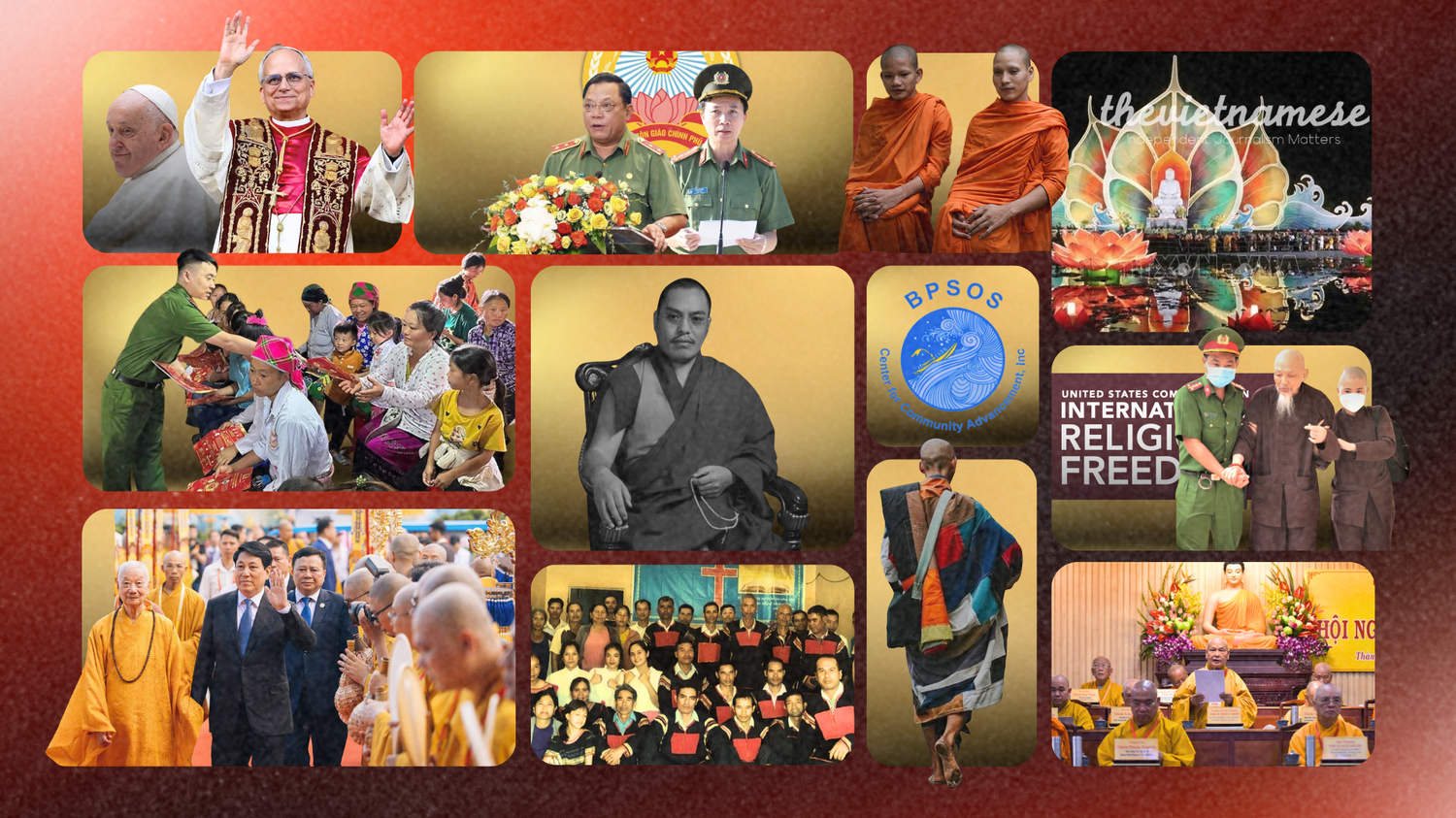
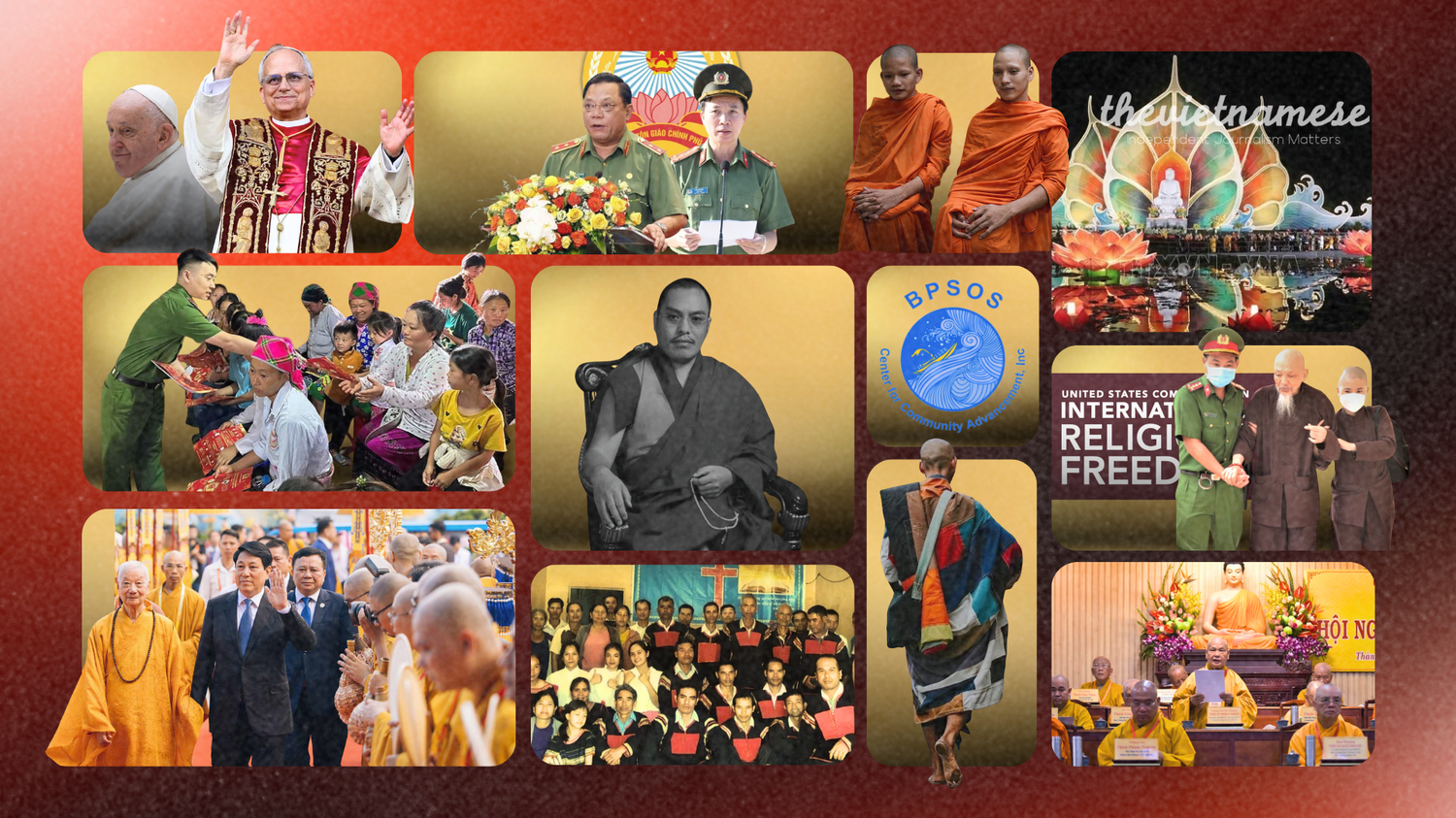
The year 2025 witnessed a series of notable religious events that had far-reaching impacts on social life, both domestically and internationally. The following ten representative events, selected by Legal Initiatives Việt Nam reporters, sketch the religious landscape of the past year.
1. The Death of Pope Francis and the Election of Pope Leo XIV
On April 21, 2025, Camerlengo Cardinal Kevin Joseph Farrell announced the death of Pope Francis at 7:35 a.m. (Rome time). The 88-year-old pontiff passed away due to a stroke and heart failure after a period of declining health, including a hospitalization for bilateral pneumonia in February.
Born Jorge Mario Bergoglio in 1936 to Italian immigrants in Buenos Aires, the late Pope led the Catholic Church for 12 years. A Jesuit with a master’s degree in chemistry, he became known as the Archbishop of Buenos Aires for his simple lifestyle—taking public buses, cooking his own meals, and ministering to the poor. Elected as the 266th pope in 2013, Francis was celebrated for his humility and dedication to social justice.
Following the vacancy of the Holy See, the conclave elected Cardinal Robert Prevost as the 267th pope on May 8, 2025. Taking the name Leo XIV, he became the first American pope and the first from the Order of Saint Augustine.
Born in Chicago in 1955, Pope Leo XIV brings extensive international experience to the papacy. He holds Peruvian citizenship from his many years of missionary work in that country. His religious life began when he joined the Order of Saint Augustine in 1977; he was ordained a priest in 1982 and completed a doctorate in canon law in 1987.
From 1999 onward, he held key leadership roles within his Order, serving as Provincial Prior in Chicago and later as Prior General of the Augustinians. In 2014, he was consecrated bishop of the Diocese of Chiclayo, Peru. His rise in the Vatican hierarchy continued in 2023, when Pope Francis appointed him Prefect of the Dicastery for Bishops and President of the Pontifical Commission for Latin America, while also elevating him to archbishop and creating him a cardinal. A polyglot, Pope Leo XIV is fluent in English, Spanish, Italian, French, and Portuguese, and is able to read Latin and German.
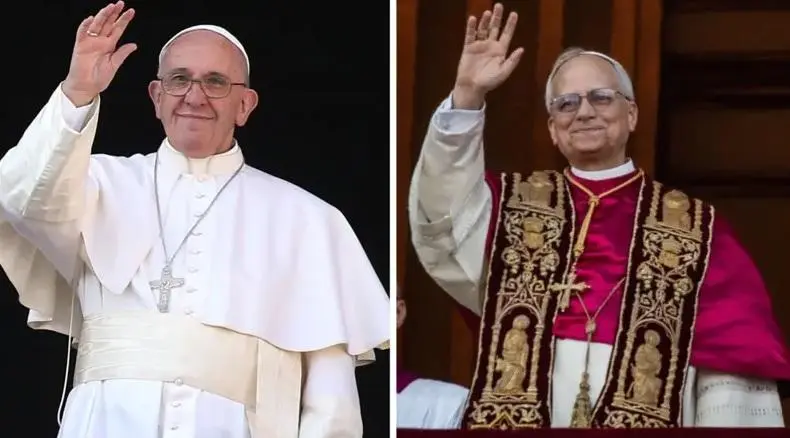
Pope Francis and Pope Leo XIV. Photo: Vatican News.
2. The U.S. Commission on International Religious Freedom Recommends Designating Việt Nam a Country of Particular Concern
On March 25, 2025, the U.S. Commission on International Religious Freedom (USCIRF) released its 2025 Annual Report, recommending that Việt Nam be designated a Country of Particular Concern (CPC) due to increasing repression of independent religious communities.
The report detailed that by the end of 2024, more than 80 individuals were detained for religious activities or advocacy. USCIRF highlighted specific cases involving Khmer Krom activists, independent Protestant believers among the Montagnards, and the prosecution of Lê Tùng Vân. The Commission noted severe persecution of Montagnard and Hmong Christians in the Central Highlands and Northwest regions, where believers face arrest, imprisonment, forced renunciation of faith, and even death after being summoned by authorities. Additionally, independent Buddhist and Cao Đài organizations faced harassment, including the destruction of facilities and bans on traditional rituals.
This followed an earlier decision in January 2024 by the U.S. Secretary of State to place Việt Nam on the Special Watch List (SWL). Vietnamese authorities rejected the USCIRF findings, claiming the report was inaccurate and unfounded. However, on Dec. 9, 2025, USCIRF issued a follow-up press release stating that the government continued to tighten control over independent religious groups.
3. The Việt Nam Buddhist Sangha Accuses Minh Tuệ of Being a “Fake Monk”
On April 16, 2025, controversy erupted when Nguyễn Minh Chí and YouTuber Trần Nguyên reported that a group allegedly affiliated with the Sri Lanka Buddhist Sangha had obstructed the pilgrimage of monk Minh Tuệ. The group presented a document, purportedly signed by Venerable Thích Nhật Từ of the Việt Nam Buddhist Sangha, labeling Minh Tuệ’s group as “fake monks.”
Shortly thereafter, another document—addressed to Sri Lanka Buddhist Sangha and bearing the signature of Venerable Thích Nhật Từ—was widely spread on social media. It accused Lê Anh Tú (Minh Tuệ) of impersonating a monk, attempting to establish a separate sect, exploiting religion for political purposes, and undermining both the unity of Vietnamese Buddhism and “state sovereignty.”
This sparked intense debate and backlash. Thích Minh Tuệ responded by asserting that he had not violated the law or exploited religion, stating he did not seek to establish a separate sect and calling for dialogue to avoid unnecessary misunderstandings. Meanwhile, Radio Free Asia (RFA) reported that a Facebook post attributed to Thích Nhật Từ denied the document’s authenticity, calling it defamatory and fabricated, though the post was later deleted.
This incident follows Minh Tuệ’s rise as a social phenomenon during his fourth cross-country pilgrimage in early 2024. Although he had been practicing ascetically since 2017, the attention in 2024 prompted the Việt Nam Buddhist Sangha to claim that individuals were exploiting his image to distort monastic life, calling for actions to prevent insults against the Sangha.
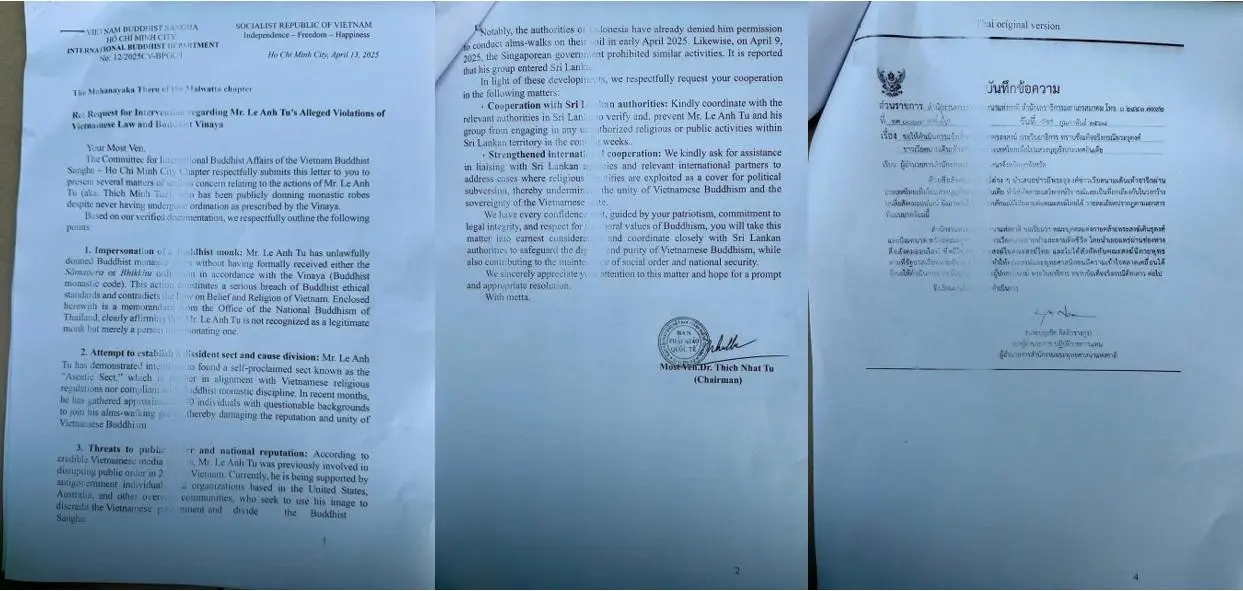
Document sent to the Sri Lanka Buddhist Sangha. Source: Nguyễn Xuân Diện.
4. Tibetan Lama Tulku Hungkar Dorje Dies and Is Secretly Cremated in Việt Nam
On April 8, 2025, the Tibetan Government-in-Exile announced the death of Tulku Hungkar Dorje, a prominent Tibetan spiritual leader, in Hồ Chí Minh City. The 56-year-old Lama reportedly died on March 29, 2025, while in the custody of Chinese and Vietnamese authorities.
The sequence of events began on March 25, when Tulku Hungkar Dorje was arrested at a hotel in Hồ Chí Minh City during a joint operation by Vietnamese police and Chinese agents. He died under unclear circumstances just days later. By April 3, a delegation of monks from Lung-ngon Monastery and Chinese officials arrived to repatriate his body. While the monastery claimed his death was due to illness, Vietnamese authorities provided no official statement.
According to RFA, attempts by followers to return his remains to Tibet were thwarted because the body had already been cremated at Long Thọ Cremation Park. Before cremation, his body was held at Vinmec Central Park International Hospital, located approximately 40 kilometers away.
Born in 1969 in Amdo province, Tulku Hungkar Dorje had arrived in Việt Nam in September 2024 to escape repression by Chinese authorities related to his advocacy for Tibetan language and culture. His death has raised serious concerns regarding human rights abuses and the extent of cross-border cooperation in the suppression of religious voices.
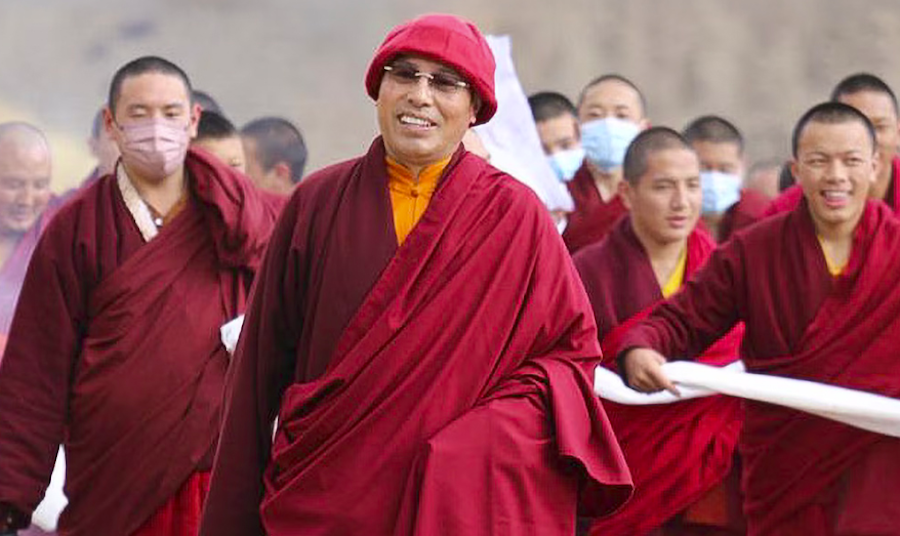
Tulku Hungkar Dorje (wearing a hat). Photo: Phayul.
5. Authorities Designate the Boat People SOS as a Terrorist Organization
On Feb. 14, 2025, the Ministry of Public Security officially designated the Boat People SOS Committee (BPSOS) as a terrorist organization. The Ministry also placed BPSOS executive director—Nguyễn Đình Thắng—on its list of “terrorist elements.”
The decision was justified by alleged links to the June 2023 attack on police and government offices in Cư Kuin District, Đắk Lắk Province. Authorities claimed BPSOS supported individuals labeled as terrorists—specifically Y Quỳnh B’đắp, Y Phik Hdok, Y Pher Hdrue, Y Aron Êban, H’ Sarina Krong, H’ Tlun Bdap, Y Ruing Knul, and H Mla Hdruẽ—in establishing the Montagnards Stand for Justice (MSFJ), a group accused of anti-state activities.
By the end of the year, on Dec. 29, 2025, authorities confirmed the arrest of Y Quỳnh B’đắp after his extradition from Thailand. While VTV Online reported that he confessed to being the ringleader of the 2023 attacks, the release of the confession video sparked suspicions of coercion.
Founded in the United States in 1990 by Nguyễn Đình Thắng, BPSOS states that its mission is to support victims of human rights violations, protect asylum seekers, and combat human trafficking. Recently, the group has been vocal regarding religious freedom for Montagnard Christians in the Central Highlands, a group frequently subjected to harassment and repression by Vietnamese authorities.
6. Religious Affairs Committee Transferred to New Ministry; Police General Retains Control
On Feb. 26, 2025, the government issued Decree No. 41/2025/NĐ-CP, formally establishing the Ministry of Ethnicities and Religions and designating it as the new managing body for the Government Committee for Religious Affairs (GCRA).
Despite the administrative transfer, the leadership remains firmly in the hands of security officials. On March 7, 2025, Minister Đào Ngọc Dung signed Decision No. 89/QĐ-BDTTG, assigning Lieutenant General Nguyễn Hải Trung—the former Director of Hà Nội Municipal Police and the Thanh Hóa Provincial Police—to oversee the committee.
This continues a trend of police oversight for the body. Previously, when the GCRA was under the Ministry of Home Affairs, it was overseen by Deputy Minister Vũ Chiến Thắng, also a former police general. Furthermore, the committee’s current daily operations are still led by Vũ Hoài Bắc, a police colonel who was appointed in 2022.
7. Việt Nam Buddhist Sangha Adopts State-Style Administrative Reforms
On March 21, 2025, the Việt Nam Buddhist Sangha (GHPGVN) announced a major restructuring plan via Giác Ngộ newspaper. In a move designed to mirror the government’s own administrative reforms, the Sangha will eliminate its district-level bodies, reducing its management system to just two tiers: provincial and grassroots. As a result, district-level congresses will be abolished.
The decision has intensified ongoing concerns regarding the Sangha’s autonomy. Established in 1981 as the only government-recognized Buddhist organization, the GHPGVN has always maintained close ties with the state. This latest alignment with state policy reinforces perceptions that the religious body functions as an extension of the government.
This structural change comes at a time when the Sangha is already facing strong public backlash. Critics have accused numerous monks of deviating from true doctrine, citing the prevalence of superstition and the “three poisons”—greed, anger, and delusion—within the organization.
8. Thái Nguyên Authorities Obstruct Religious Activities at Thuận Phong Mission Station
On Aug. 11, 2025, the Bắc Ninh Diocese reported an incident of obstruction by authorities in Thái Nguyên Province at the Thuận Phong mission station (Đại Từ Parish). During a Mass, officials cut off electricity to the area, forcing believers to continue the service in darkness, lit only by altar candles and mobile phones.
Authorities initially justified the action by claiming the mission station was not licensed for religious activities. Parishioners, however, explained that the site served elderly residents and children who were unable to travel to the main Đại Từ Church.
A meeting was held on July 16, 2025, between the diocese and provincial officials, including the deputy director of the Department of Ethnicities and Religions and the Đại Từ commune Party secretary. During the session, authorities admitted that the power cut was an “impulsive act” by subordinates that lacked sensitivity. They pledged to learn from the mistake and ensure it would not happen again.
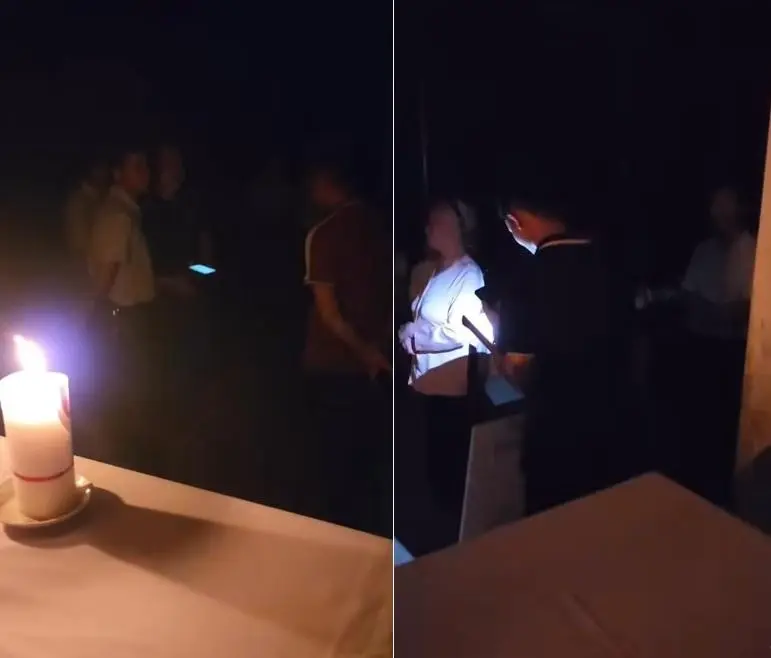
Image of authorities cutting electricity during Mass. Screenshot from video.
9. Authorities Ramp up Prosecution of Independent Religious Believers with Harsher Sentences
Throughout 2025, Vietnamese authorities intensified their crackdown on independent religious communities, utilizing Articles 331 (“abusing democratic freedoms”) and 116 (“sabotaging national unity policies”) of the 2015 Penal Code to impose heavy prison sentences.
The year saw a series of harsh verdicts targeting independent Protestants, Hòa Hảo Buddhists, and Khmer Krom Buddhists:
- February: Independent Protestant believer Nguyễn Mạnh Hùng was sentenced to six years in prison for social media posts regarding religious freedom.
- May: In Đắk Lắk, Y Pŏ Mlô received seven years and six months in prison under Article 116 for organizing religious activities and communicating with overseas individuals alleged to have ties to Fulro. Another believer, Y Thinh Niê, was sentenced to nine years under the same article for establishing an unrecognized group and online religious participation.
- July: An Giang authorities sentenced Hồ Trọng Phúc, an independent Hòa Hảo Buddhist, to one year in prison under Article 331. He was under 18 years old at the time of sentencing.
- November: Three Khmer Krom Buddhists—Thạch Nga, Kim Som Rinh, and Thạch Xuân Đồng—were sentenced by Vĩnh Long authorities to three years and six months in prison under Article 331 for Facebook comments about religious freedom.
These cases illustrate a trend toward criminalizing peaceful religious activities through broadly interpreted laws. Penalties have escalated compared to previous years, particularly against ethnic minorities, as the state increasingly frames independent religious practice as a national security threat.
10. Việt Nam Successfully Hosts the 2025 United Nations Vesak Celebration
From May 6 to May 8, 2025, Việt Nam hosted the 20th United Nations Day of Vesak, marking the fourth time the country has held this prestigious event (following 2008, 2014, and 2019). The celebration concluded at the Việt Nam Buddhist Academy in Hồ Chí Minh City, attended by over 2,700 delegates from 85 countries under the theme “Unity and Inclusivity for Human Dignity: Buddhist Insights for World Peace and Sustainable Development.”
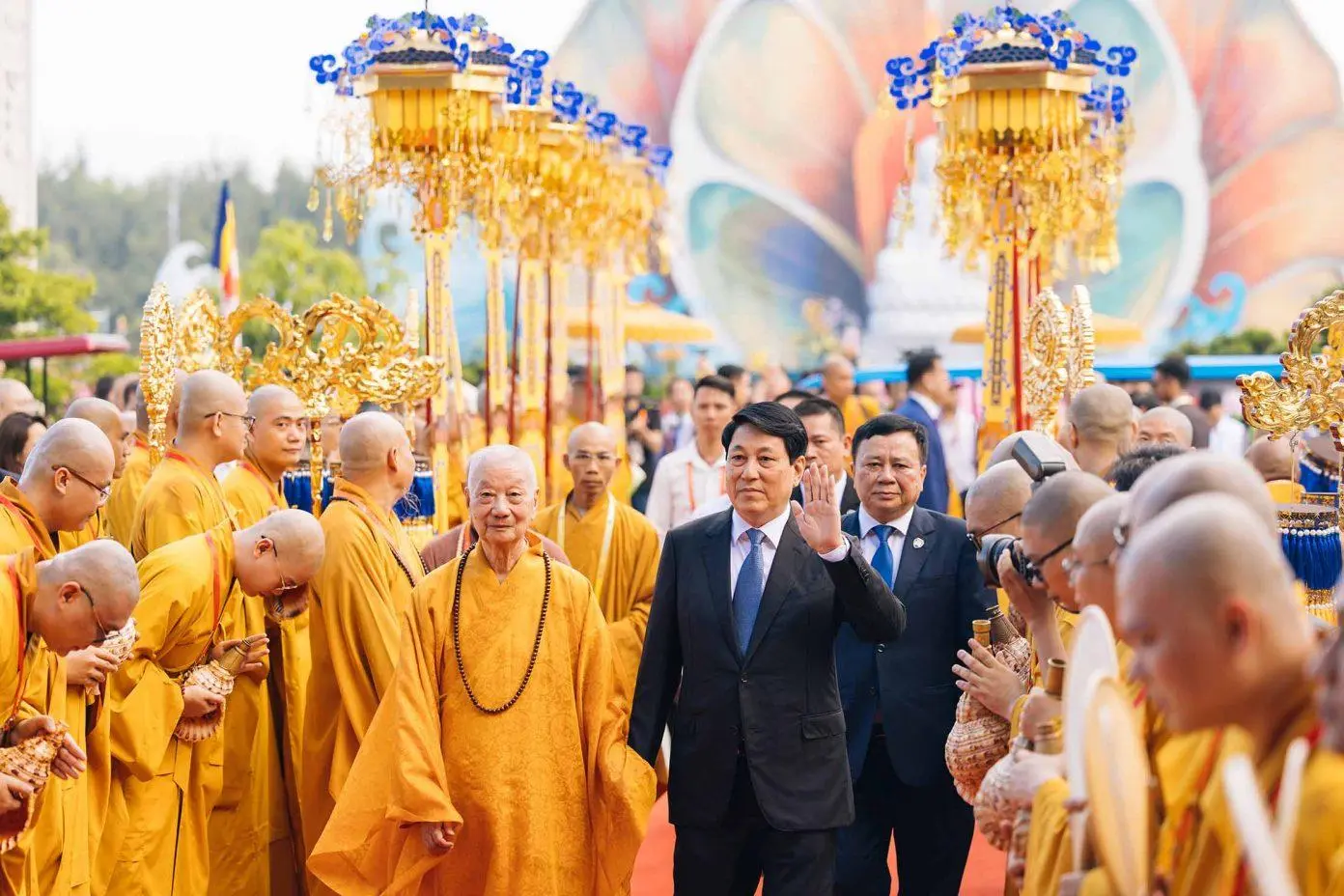
State President Lương Cường attends the opening ceremony of Vesak 2025. Photo: Ho Chi Minh City Press Center.
A highlight of the event was the display of Buddha relics brought from India. With government permission, the Việt Nam Buddhist Sangha organized public veneration ceremonies not only in Hồ Chí Minh City but also in Ninh Bình, Bắc Giang, Quảng Ninh, Hưng Yên, and Đà Nẵng.
The successful organization of the event underscores the position of the Việt Nam Buddhist Sangha, which remains the only Buddhist organization in the country officially recognized by the government and authorized to conduct national and international celebrations.
—
Thiện Trường wrote this article in Vietnamese and published it in Luật Khoa Magazine on Jan. 9, 2026. Đàm Vĩnh Hằng translated it into English for The Vietnamese Magazine.