
On Sept. 30, 2025, the UN Human Rights Council’s Special Procedures issued Joint Allegation Letters (JAL) to Samsung Electronics and the governments of South Korea and Việt Nam. The letters allege that Samsung, the flagship of South Korean industry, engaged in “irresponsible chemicals management” and environmental pollution at its facilities in Việt Nam, which may violate fundamental rights to health, safe water, and a clean environment.
While the Samsung PR machinery issues neutered and cherry-picked reports featuring verdant landscapes and promises of a “sustainable future,” the UN correspondence presents a drastically different picture—one of untreated wastewater, toxic fumes, and a corporate culture that skirts environmental regulations and workers’ rights.
A Toxic Relationship
By 2022, Samsung had become the largest foreign investor in Việt Nam, employing 100,000 people and producing half of its global mobile phone supply. This dominance secured the company massive tax incentives, including a 10% corporate income tax rate for 27 years. However, this economic success hides a disturbing history of willful negligence.
UN reports indicate that Samsung’s Bắc Ninh factory operated without a proper toxic wastewater treatment system from 2010 to 2013. During this time, industrial chemicals and raw sewage reportedly overflowed into the environment while subcontractors dumped materials into local waters. While Samsung revolutionized the smartphone market, its operations in Việt Nam caused significant environmental harm.
The pollution also affected the air. Between 2010 and 2017, the Bắc Ninh factory reportedly used an undersized air pollution control facility. Instead of reducing production to match the facility’s capacity, the company allegedly removed filters and activated carbon, venting toxic dust directly into the air. Nearby residents described the odors as “torture” and reported chronic illnesses Furthermore, the JAL noted that internal Samsung reports from as early as 2012 show that high-level managers were aware of these violations but allowed them to continue.
The human impact is particularly evident among Samsung’s female workers. A 2017 survey of 45 women working at Samsung’s factories in Việt Nam, cited in the JAL, documented issues such as fainting, dizziness, miscarriages, and joint pain from 9 to 12-hour shifts. When the Research Centre for Gender, Family and Environment in Development (CGFED) published these findings, Samsung responded with intimidation, a smear campaign, and threats of legal action against the researchers.
In May 2024, a whistleblower using the pseudonym Kang, a former Samsung safety manager, revealed that the company exploited the absence of a Pollutant Release and Transfer Registry (PRTR) in Việt Nam. While Samsung is legally required to report over 400 pollutant and hazardous substances in South Korea, it took advantage of the lack of mandatory transparency in Việt Nam to obscure its emissions. Consequently, the company continues to employ practices in Việt Nam that would be illegal on its home turf.
A Global Pattern of Transgressions
Samsung’s actions in Việt Nam are not isolated incidents. Its track record across the globe suggests that labor rights and environmental safety are often secondary to production targets.
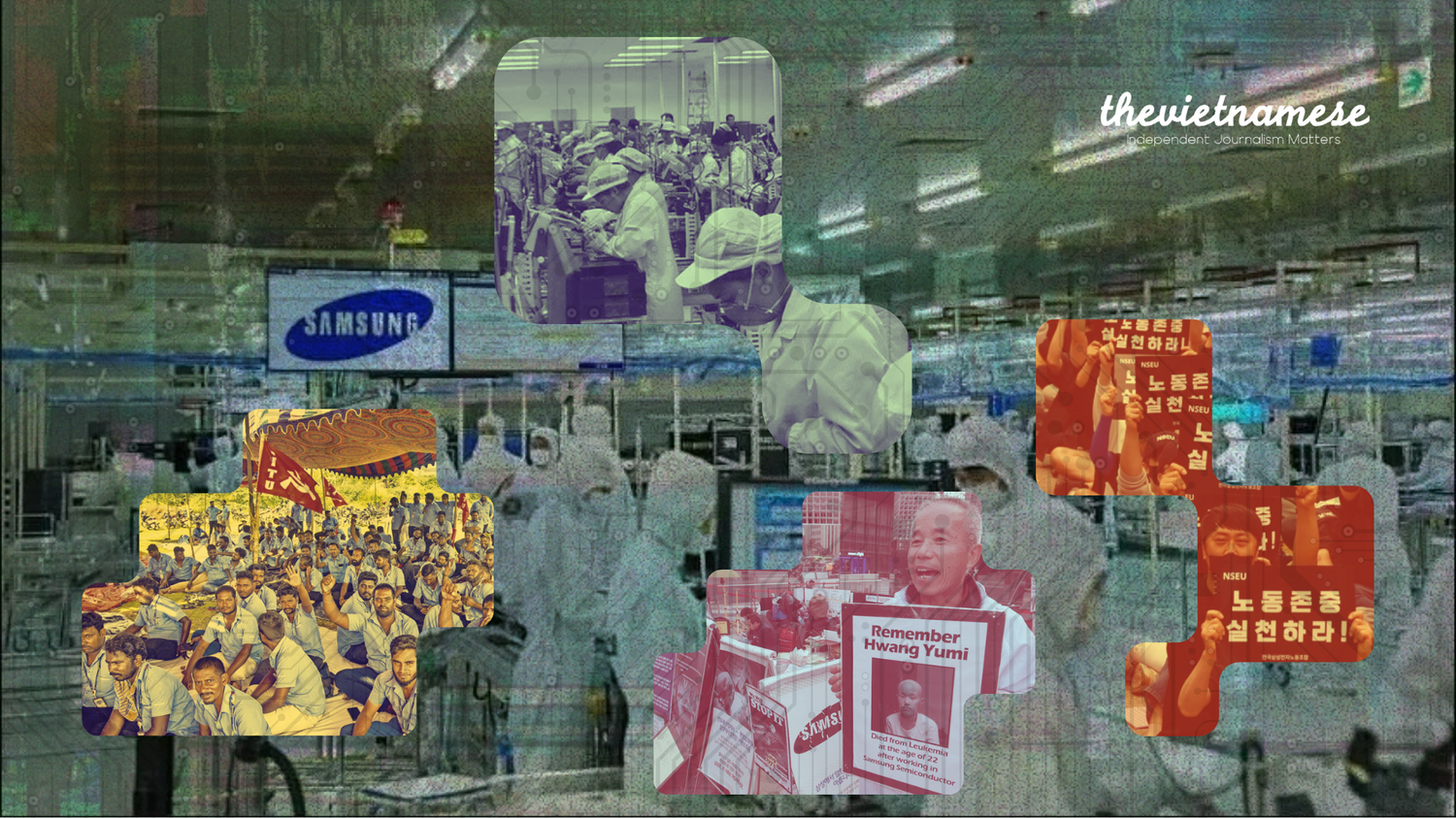
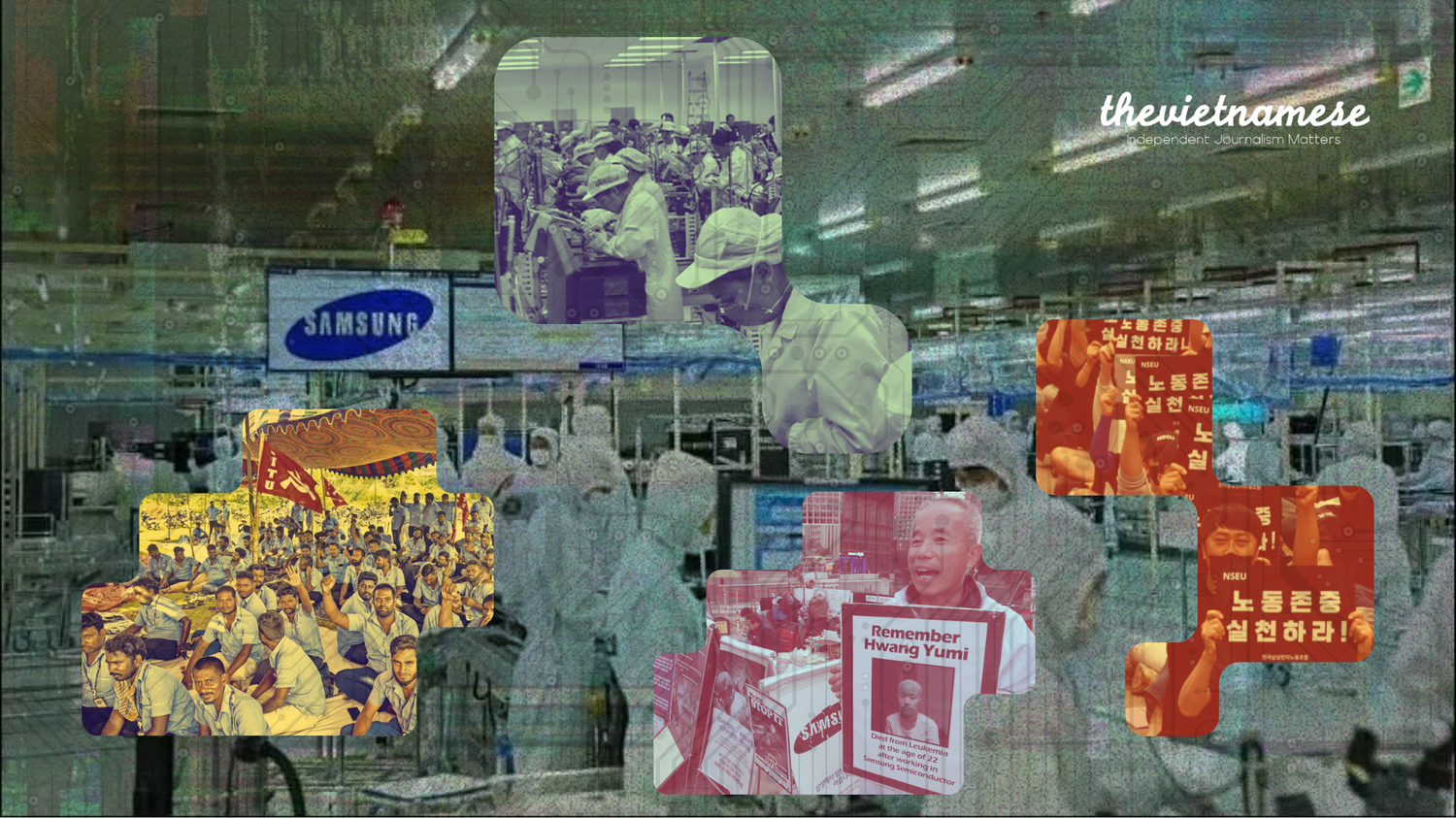
In late 2024, over 1,000 workers at Samsung’s plant in Chennai, India, launched an indefinite strike demanding the recognition of their union, the Samsung India Workers Union (SIWU). The workers demanded better wages and working conditions, alleging they were receiving inadequate rest breaks. The strike lasted 37 days, during which time police detained workers for protesting. After a lengthy legal battle and a high court judgment, SIWU was officially recognized and registered in January 2025.
This was a landmark victory. SIWU was only the second Samsung union globally to win formal recognition, highlighting the company’s long-standing, aggressive opposition to independent labor organizations.
In Brazil, the company faced a lawsuit in 2013 from the Ministry of Labour seeking $108 million in damages. Inspectors discovered that workers were subjected to up to 15-hour workdays and insufficient breaks, with prosecutors alleging that 2,000 workers suffered health problems, such as back injuries, due to working conditions. This lawsuit followed a previous prosecution in 2011—also for poor working conditions—where Samsung paid a settlement of about $200,000.
Malaysia has also been a victim of systemic exploitation within Samsung’s supply chain. In 2016, a Guardian investigation revealed that migrant workers making products for the company in Malaysia were trapped in debt bondage, having paid exorbitant recruitment fees, and had their passports confiscated.
In November 2025, UN experts stated that such exploitation remains a “widespread and systematic” issue in Malaysia, with experts sounding the alarm over the continued deception and debt bondage of Bangladeshi migrant workers. While Samsung denies direct involvement, the recurrence of these allegations within its supply chain points to the company’s willful negligence or failure to enact any meaningful change.
Perhaps the most harrowing chapter in Samsung’s history is found in its home country of South Korea. For years, workers in semiconductor plants suffered from leukemia, lymphoma, and other serious diseases. The company vehemently denied a link between the workplace environment and these illnesses, even as young workers died. It took over a decade of activism by SHARPS (Supporters for the Health and Rights of People in the Semiconductor Industry) for Samsung to finally issue an apology in 2018 and establish a compensation scheme.
Furthermore, Samsung executives were also convicted for orchestrating a group-wide union-busting campaign, confirming that the suppression of labor organizations was a directive from the very top.
The Corporate Facade
Samsung’s corporate literature depicts a reality that is fundamentally at odds with the findings of NGOs and UN experts. The company’s 2025 Sustainability Report flaunts a “New Environmental Strategy” focused on net zero emissions and resource circularity. They claim that 93.4% of energy consumption in the Device eXperience (DX) division has transitioned to renewable energy and that they are strictly complying with environmental laws.
However, the inconsistencies between Samsung’s public relations rhetoric and other accessible information are quite clear. While claiming to respect human rights and the right to collective bargaining in their policy documents, Samsung has reportedly lobbied against the ratification of ILO Convention No. 87 by Việt Nam, which guarantees the freedom of association, arguing that multiple unions would lead to instability.
In South Korea, the company withheld critical data—claiming it was “trade secrets”—to block the release of health and safety data that sick workers needed to claim compensation, effectively prioritizing corporate secrecy over human life.
Samsung’s oversight of its supply chain in Việt Nam also fails to meet its stated “Business Principles“:
- We comply with laws and ethical standards.
- We maintain a clean organizational culture.
- We respect customers, shareholders, and employees.
- We care about the environment, health, and safety.
- We are a socially responsible corporate citizen.
Despite these principles, the JAL asserts that the company had over 13,000 compliance violations at supplier factories in Việt Nam over a four-year period. These violations include air pollution and poor waste management, yet business with these suppliers largely continued. The system relies heavily on suppliers to self-report their handling of toxic chemicals, a method that practically invites data manipulation to secure contracts.
Even in the realm of environmental protection, the narrative creates friction with the facts. While Samsung celebrates its Alliance for Water Stewardship (AWS) Platinum certification for “excellence in water management,” it omitted a significant 2022 incident from its reports. In that year, its Austin, Texas, semiconductor plant spilled nearly 3 million liters of toxic wastewater, devastating local aquatic life for months.
Conclusion
Despite the polished corporate public relations and the endless stream of sustainability accolades, Samsung continues to demonstrate that it is not as clean as it claims to be. The evidence—from the untreated sewage in Bắc Ninh to the union-busting in Chennai and the leukemia clusters in Suwon—suggests that the company views human rights and environmental regulations as operational hurdles that limit revenue.
This is not at all surprising. Samsung is, first and foremost, a business; its loyalty remains tethered to income and the bottom line. Despite all the self-published reports claiming otherwise, corporations will do the bare minimum to comply with human rights norms. They will only be compelled to act by litigation or—rarely—by public pressure.
The government of Việt Nam is failing in its duty to hold such powerful entities accountable. By granting approvals to factories with undersized pollution controls and offering massive tax holidays, the state has prioritized foreign direct investment over the health, safety, and preservation of its own people and the environment.
The lack of a mandatory PRTR system in Việt Nam allowed Samsung to hide emissions that it would have been forced to disclose in South Korea, indicating that it will exploit weaker regulatory frameworks whenever possible.
The responsibility, therefore, partially falls to watchdogs, NGOs, and trade unions to keep these greedy corporate entities in check. But ultimately, it is the governments of nations where these corporations operate that must enforce the rules.
They need to ensure that their citizens are not treated as disposable components in a global supply chain and that the environment is not treated as a free dumping ground. Until regulatory bodies prioritize public health over corporate profit, the clean tech in consumer pockets will continue to carry a very dirty legacy.
References:
- Associated Press. (2013, August 14). Brazil sues Samsung over labour violations. The Guardian. https://www.theguardian.com/world/2013/aug/14/brazil-sues-samsung-labour-violations
- Bandyopadhyay, O. (2025, February 9). Samsung workers in Chennai win union recognition following lengthy legal battle. British Safety Council. https://www.britsafe.in/safety-management-news/2025/samsung-workers-in-chennai-win-union-recognition-following-lengthy-legal-battle
- Grossman, E. (2011, June 9). Toxics in the ‘Clean Rooms’: Are Samsung Workers at Risk? Yale Environment 360. https://e360.yale.edu/features/toxics_in_the_clean_rooms_are_samsung_workers_at_risk
- IPEN. (2024, May). INVESTIGATIONS BY SAMSUNG SHOW IRRESPONSIBLE CHEMICALS MANAGEMENT AND POLLUTION OF VIETNAM’S ENVIRONMENT. https://ipen.org/sites/default/files/documents/ipen_samsung_pollution_korean_report-final-compressed.pdf
- Office of the High Commissioner for Human Rights (OHCHR). (2025, November 21). Malaysia: UN experts sound alarm over continued systematic exploitation of Bangladeshi migrant workers. https://www.ohchr.org/en/press-releases/2025/11/malaysia-un-experts-sound-alarm-over-continued-systematic-exploitation
- Orellana, M. A., Yeophantong, P., Riaño, A. P., Romero, G., Katrougalos, G., Alsalem, R., Arrojo-Agudo, P., & Flores, C. (2025, September 30). Mandates of the Special Rapporteur on the implications for human rights… to the Government of the Republic of Korea (Ref.: AL KOR 5/2025). Office of the United Nations High Commissioner for Human Rights. https://spcommreports.ohchr.org/TMResultsBase/DownLoadPublicCommunicationFile?gId=30364
- Orellana, M. A., Yeophantong, P., Riaño, A. P., Romero, G., Katrougalos, G., Alsalem, R., Arrojo-Agudo, P., & Flores, C. (2025, September 30). Mandates of the Special Rapporteur on the implications for human rights… to the Government of Viet Nam (Ref.: AL VNM 6/2025). Office of the United Nations High Commissioner for Human Rights. https://spcommreports.ohchr.org/TMResultsBase/DownLoadPublicCommunicationFile?gId=30360
- Orellana, M. A., Yeophantong, P., Riaño, A. P., Romero, G., Katrougalos, G., Alsalem, R., Arrojo-Agudo, P., & Flores, C. (2025, September 30). Mandates of the Special Rapporteur on the implications for human rights… to Samsung Electronics (Ref.: AL VNM 6/2025). Office of the United Nations High Commissioner for Human Rights. https://spcommreports.ohchr.org/TMResultsBase/DownLoadPublicCommunicationFile?gId=30366
- Pattisson, P. (2016, November 20). Samsung and Panasonic accused over supply chain labour abuses in Malaysia. The Guardian. https://www.theguardian.com/global-development/2016/nov/21/samsung-panasonic-accused-over-supply-chain-labour-abuses-malaysia
- Pham, T. M. H., & DiGangi, J. (2017, December 18). Reference: Samsung response to CGFED – IPEN report on working conditions in Samsung’s factories in Vietnam [Letter to Phil Bloomer]. CGFED & IPEN. https://media.business-humanrights.org/media/documents/files/documents/Response_to_Samsung_BHRRC_18_Dec_2017.pdf
- Samsung Electronics. (2023, February). Global Human Rights Principles. https://www.samsung.com/global/sustainability/policy-file/AYZO1Ym6CLsALYN7/Samsung%20Electronics%20Global%20Human%20Rights%20Principles%20(policy)_2023_3.pdf
- Samsung Electronics. (2023, April 24). Samsung Electronics’ response to methanol poisoning deaths and hospitalisations in Vietnam. Business & Human Rights Resource Centre.
- Samsung Electronics. (2024). A Journey Towards a Sustainable Future: Samsung Electronics Sustainability Report 2024. https://www.samsung.com/global/sustainability/media/pdf/Samsung_Electronics_Sustainability_Report_2024_ENG.pdf
- Samsung Electronics. (2024, August 9). Samsung Electronics’ position on EHS management in Vietnam. Business & Human Rights Resource Centre. https://www.business-humanrights.org/en/latest-news/samsung-electronics-position-on-ehs-management-in-vietnam/
- Samsung Electronics. (2025). A Journey Towards a Sustainable Future: Samsung Electronics Sustainability Report 2025. https://www.samsung.com/global/sustainability/media/pdf/Samsung_Electronics_Sustainability_Report_2025_ENG.pdf