
Key Events
- Lê Trung Khoa and Nguyễn Văn Đài Sentenced to 17 Years in Absentia;
- Y Quỳnh B’Đăp Appears on VTV, Confesses to Đắk Lắk Attack in June 2023;
- Communist Party Casts Community Leaders as “Core Force” of Security in Central Highlands;
- Việt Nam’s Application Zalo Retreats after Backlash over Data Terms
17-Year Prison Sentences Issued in Absentia for Lê Trung Khoa and Nguyễn Văn Đài
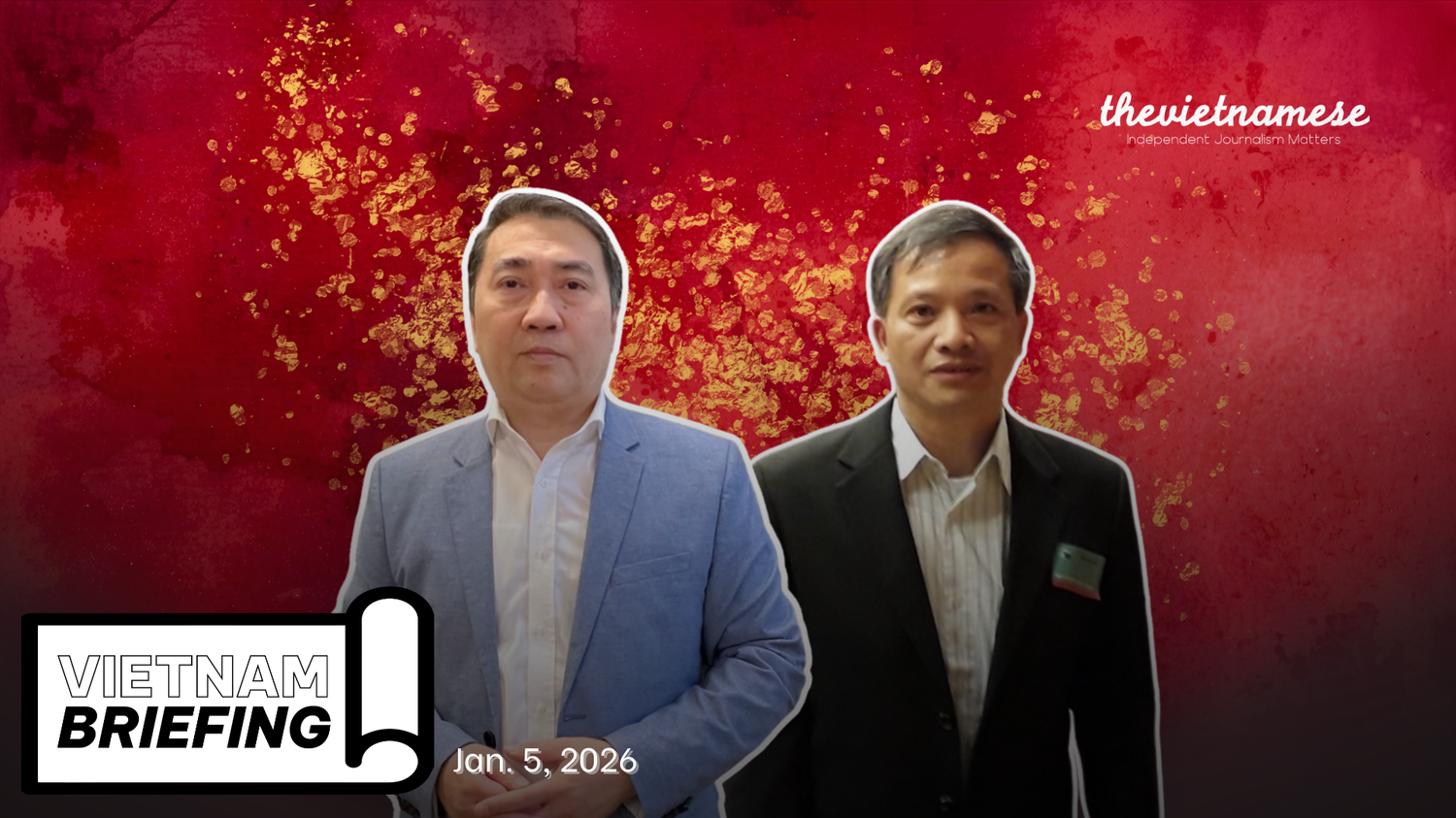
On the final day of the year, two political trials involving Lê Trung Khoa and Nguyễn Văn Đài concluded in Hà Nội with heavy prison terms for what authorities described as “anti-state propaganda.”
Both defendants were tried in absentia, and each received a 17-year prison sentence.
On Dec. 31, the Hà Nội People’s Court held trials for Khoa, Đài, and several co-defendants, charging them under Article 117(2) of Việt Nam’s 2015 Criminal Code—“making, storing, disseminating, or propagandizing information or materials against the Socialist Republic of Việt Nam.”
In Khoa’s case, the court also tried Đỗ Văn Ngà, Phạm Quang Đức, and Phạm Quang Thiện. Ngà, Đức, and Thiện are currently in detention, while Khoa was tried in absentia because he is reportedly living in Germany. The trial sentenced Khoa to 17 years in prison, describing him as the “mastermind and ringleader” who allegedly recruited others to commit the offenses.
According to the indictment, since 2016 Khoa had used 12 online webpages to post articles and videos on social media that authorities claimed “distorted and slandered” the government. The other defendants were accused of “assisting” by producing and uploading related content.
In a separate hearing the same day, Nguyễn Văn Đài—also tried in absentia—received the same 17-year sentence.
Prosecutors alleged that Đài directly managed nine social media accounts and channels used to publish articles and video clips deemed “fabricated” and “anti-state.” The proceedings asserted that these activities “infringed national security, caused public anxiety, and damaged Việt Nam’s international image.”
Nguyễn Văn Đài has prior convictions. In 2007, he was sentenced to four years in prison for “anti-state propaganda” and served the term.
In 2015, he was arrested and was convicted of “attempting to overthrow the people’s administration” and sentenced to 15 years in a 2018 trial. However, Việt Nam later suspended the sentence and allowed him to leave for political asylum in Germany, citing medical reasons.
These trials against Lê Trung Khoa and Nguyễn Văn Đài took place just 19 days before the 14th National Party Congress (Jan. 19–25, 2026). Since early December, Vietnamese authorities had reportedly asked Facebook to block content by Khoa and Đài within Việt Nam.
After the verdicts, both men publicly rejected the rulings. Khoa called the proceeding an “imposed trial” targeting his independent journalism and said the sentence would not halt his reporting, pledging to continue publishing in multiple languages.
Đài mocked the judgment, referring to the 17 years as an “additional gift” atop a prior sentence and vowing not to accept it.
Ahead of the trials, Đỗ Văn Ngà was the only co-defendant to appear on state television, confessing on VTV on Dec. 28. Nearly two months earlier, he was reported missing after boarding a flight to Hồ Chí Minh City.
Việt Nam’s state media did not specify which materials were deemed “anti-state.” And neither the names of the court-appointed defesne counsel nor their arguments have been made public.
Extradited Activist Y Quỳnh B’Đăp Appears on State TV, Confesses to Đắk Lắk Attack
For the first time since being extradited to Việt Nam in late November, Montagnard activist Y Quỳnh B’Đăp appeared on state television, confessing that he had “directed” the 2023 attack on police facilities in Đắk Lắk Province and stating that he was not tortured by the police.
On the evening of Dec. 29, Vietnam Television (VTV) published an online report titled “Extraditing Y Quỳnh B’Đăp – the Ringleader of the Đắk Lắk Terrorist Attack,” accompanied by a video showing both his televised confession and scenes of his daily life in detention.
In the video, Y Quỳnh says that during the June 11, 2023 attack, he and his organization, Montagnards Stand for Justice (MSFJ), were “among the organizations involved in that terrorist act,” adding that he personally “directed the attack on police headquarters in two communes, Ia Ktur and Ia Tiêu.”
The Vietnamese Magazine has no evidence confirming that Y Quỳnh B’Đăp’s confession was coerced.
The broadcast also shows Y Quỳnh’s detention conditions following his extradition. He is seen meeting family members, staying in a cell with ample light, watching television, and taking part in outdoor activities.
Y Quỳnh states that police officers did not threaten him, while relatives appearing in the video say that he is eating and living normally.
VTV did not disclose where Y Quỳnh B’Đăp is currently being held.
Y Quỳnh and MSFJ have long advocated for the basic rights of Montagnard communities in Việt Nam’s Central Highlands. On Nov. 28, 2025, the Thai government extradited him to Việt Nam, confirming that he was handed over to Vietnamese authorities just two days after a final appellate hearing in Bangkok.
Earlier, on Jan. 20, 2024, the Đắk Lắk People’s Court sentenced Y Quỳnh B’Đăp in absentia to 10 years in prison for “terrorism” in connection with the June 11, 2023 attack in Cư Kuin district. Y Quỳnh rejected the accusation, insisting that he was not in Việt Nam when the attack occurred.
Y Quỳnh B’Đăp was arrested in Thailand on June 11, 2024. Although he had been recognized as a refugee by the UNHCR in 2019, a Thai court ruled on Sept. 30, 2024, in favor of extraditing him to Việt Nam.
He appealed the decision, but on Nov. 26, 2025, Thailand’s appellate court upheld the ruling, making it final and immediately enforceable. Two days later, the Thai government announced that Y Quỳnh B’Đăp had been extradited.
After his transfer, no official information was released about his health or legal status until VTV published the video on Dec. 29, 2025.
The broadcast came one day after VTV aired another televised confession by Đỗ Văn Ngà, a defendant in the case involving journalist Lê Trung Khoa.
Ngà said he had cooperated with thoibao.de while abroad and returned to Việt Nam to “face the law,” asking for leniency. Before that broadcast, his whereabouts had been unknown since his arrest at Tân Sơn Nhất Airport on Nov. 8, 2025.
Televised confessions have been a recurring practice in Việt Nam. A 2021 study by Thi Thanh Phuong Nguyen-Pochan documented such cases involving political defendants between 2009 and 2020. However, a joint report submitted on May 26, 2025 by the World Organisation Against Torture (OMCT) and the Vietnamese Advocates for Change warned that Vietnamese human rights defenders face enforced disappearances, transnational repression, incommunicado detention, torture, and judicial harassment. The report also notes that Việt Nam’s courts are not independent and remain under the control of the Communist Party, to which all judges belong.
Party-linked Army General Urges Village and Religious Leaders to Uphold Security in Central Highlands
Meeting with community representatives in Việt Nam’s Central Highlands, Army Gen. Nguyễn Trọng Nghĩa said village elders, hamlet heads, respected local figures, and religious dignitaries are the “core of the people’s security posture” in safeguarding national defense and security in the region.
General Nghĩa made the remarks on Dec. 29, 2025 at a routine conference organized by the Political General Department in Gia Lai Province.
He called on influential figures in the Central Highlands to continue “promoting their roles, prestige, and influence” in mobilizing clans, local communities, believers, and congregations to comply with the Communist Party’s guidelines and the state’s laws and policies.
The general also urged local party committees and authorities to “fully and correctly recognize” the importance of these community figures in ethnic minority areas.
The comments reflect long-standing party policy toward the Central Highlands, a region the Communist Party considers strategically vital. Under Politburo Resolution 23-NQ/TW, the area is defined as having “particularly important strategic significance” in terms of economic development, politics, culture, society, environment, national defense, security, and foreign affairs.
At the same time, the resolution acknowledges that political security, religious affairs, ethnic relations, petitions, and land disputes in the region “still contain potentially complex factors.” Against this backdrop, building a “firm people’s security posture” and strengthening the role of village leaders and respected community figures have been identified as key objectives.
Within party discourse, the concept of a “people’s security posture” is framed as fostering “absolute trust” among the population in the Communist Party’s leadership, alongside maintaining social stability. As a strategic priority, the Political General Department of the military has been tasked as the core body responsible for researching and advising the Party on how to implement this approach.
This line of policy was reinforced in Conclusion 65-KL/TW, issued by the party’s Central Committee on Oct. 30, 2019. The document emphasizes mobilizing influential ethnic minority figures as a means to “counter activities that exploit belief and religion to affect political security and social order.”
The remarks come amid persistent domestic and international concern over religious freedom in the Central Highlands and across Việt Nam. In March 2025, the Annual Report of the United States Commission on International Religious Freedom again recommended that Việt Nam be designated a Country of Particular Concern for severe violations of religious freedom.
The Vietnamese authorities have consistently rejected these assessments. However, throughout 2025, security forces continued to harass and detain Montagnard Christians affiliated with the Evangelical Church of Christ in the Central Highlands.
Since large-scale protests in 2001 demanding religious freedom and land rights, Montagnard communities in the region have faced sustained repression. Thousands have been forced to flee their ancestral lands and seek refuge in third countries, a legacy that continues to shape tensions between state security policy and ethnic minority religious life in the Central Highlands.
Public Pressure Forces Zalo to Soften Controversial Data Terms
Zalo, Việt Nam’s dominant messaging app, significantly altered its controversial data policy following widespread public criticism and regulatory scrutiny, triggering a rare public debate over privacy, consent, and platform control just days before the nation’s new personal data protection law took effect on Jan. 1, 2026.
The dispute began on Dec. 26, when millions of Zalo users in Việt Nam received a mandatory update to the app’s terms of service requiring them to “accept all” new conditions or risk having their accounts deleted within 45 days if they refused.
The provision — widely portrayed as a take-it-or-lose-your-account ultimatum — sparked intense user concern about how much personal information the platform would be able to collect and process.
According to the detailed terms outlined by Luật Khoa Magazine, the updated policy would give Zalo broad access to users’ personal data from initial account setup through ongoing use, encompassing identifiers such as phone numbers, full names, birth details, gender, and government IDs, as well as social relationships drawn from address books, photos, avatars, and user-generated content.
It also referenced deeper device-level data like IP addresses and real-time GPS location, and indicated an ability to assign and use a unique Zalo ID to track behavior across the platform.
The terms further stated that Zalo would be fully exempt from liability for security failures and could use or share collected data with third parties under certain conditions, including at the request of state authorities.
The policy also includes strict content moderation clauses addressing politically sensitive material. Users pushing back online described feeling “held hostage” by the app, and quickly flooded the App Store and Google Play with one-star reviews.
Within days, public outcry spread across social media, with some users urging a boycott or switching to international messaging alternatives. Market ranking data show Zalo dropping out of the top 200 free Android apps in Việt Nam, a notable decline for a platform that long dominated the local market.
Responding to the backlash, Zalo issued a statement on Dec. 31 saying it would not delete user accounts after 45 days of non-acceptance, a softening of its original position. Instead, it said it would remove previously collected data from users who decline the updated terms — though it did not specify which data would be erased or how the process would work.
The Vietnam National Competition Commission has also asked parent company VNG Corp. to revise the terms to ensure users are not forced into blanket consent and to ensure compliance with consumer protection and data privacy laws. Authorities have yet to clarify whether deeper legal action will follow.
The episode highlights growing public sensitivity around digital privacy and consent in Việt Nam, particularly as the Personal Data Protection Law comes into force. Although Zalo and some cybersecurity experts argue that updates to terms are common across apps worldwide, critics say the combination of mandatory consent, lack of transparency, and proximity to new legal standards makes this a pivotal moment in how Vietnamese tech platforms balance user rights with data-driven business models.
Quick Takes:
Missing Defendant Đỗ Văn Ngà Appears on VTV, Confesses Days Before Lê Trung Khoa Trial
After nearly two months of disappearance and just three days before the trial in the Lê Trung Khoa case, defendant Đỗ Văn Ngà appeared on state television and delivered a confession. On the evening of Dec. 28, Vietnam Television aired footage of Ngà admitting to writing articles for thoibao.de that authorities labeled “anti-state,” saying he did so for online views and income. Ngà had been missing since Nov. 8, when he landed at Tân Sơn Nhất Airport. The International Federation of Journalists later confirmed his arrest under Article 117, amid criticism over the timing and transparency of the proceedings.
Party and State Distribute Cash Gifts via VNeID for Second Time in Six Months
On Dec. 28, 2025, the Vietnamese government issued Resolution 418/NQ-CP on “party and state gifts” ahead of the 14th Party Congress and Lunar New Year. Eligible recipients include people with revolutionary merit, social welfare beneficiaries, pensioners, and orphans, each receiving 400,000 đồng ($15.21) from the central budget. The Ministry of Public Security was tasked with disbursing payments through social security accounts on VNeID, using bank transfers or cash as alternatives. Although funded by taxpayers, state media described the payments as gifts from the party and state, reviving concerns over digital control and data collection following a similar VNeID payout in September 2025.
German Embassy Facebook Post on Human Rights Draws Thousands of Comments Ahead of Political Trials
A post on the Facebook page of the German Embassy in Hanoi on human rights drew more than 3,000 comments within 48 hours, just days before the trials of Lê Trung Khoa and Nguyễn Văn Đài. Posted on the evening of Dec. 29, the entry quoted a speech by UN Secretary-General António Guterres affirming that human rights are central to peace and security. The post generated over 4,600 interactions, with many Việt Nam-based users leaving pro-government or critical comments. The timing, two days before the Dec. 31 hearings in Hanoi, drew particular attention.
Hà Nội Police Arrest Ngọc Việt Education Director after Canceled Concert
On the evening of Dec. 30, state media reported that Hà Nội police had detained Nguyễn Thị Thu Hà, director of Ngọc Việt Education, on charges of “fraudulent appropriation of property” under Article 174 of the 2015 Criminal Code. The case follows the abrupt cancellation of the concert “Về đây bốn cánh chim trời” (Come Home, The Four Birds of the Open Sky) on Dec. 28, after tickets priced from 700,000 to 7 million đồng ($27 to $266) had sold out. Authorities moved quickly despite recent party resolutions calling for restraint in criminalizing economic and civil disputes.