
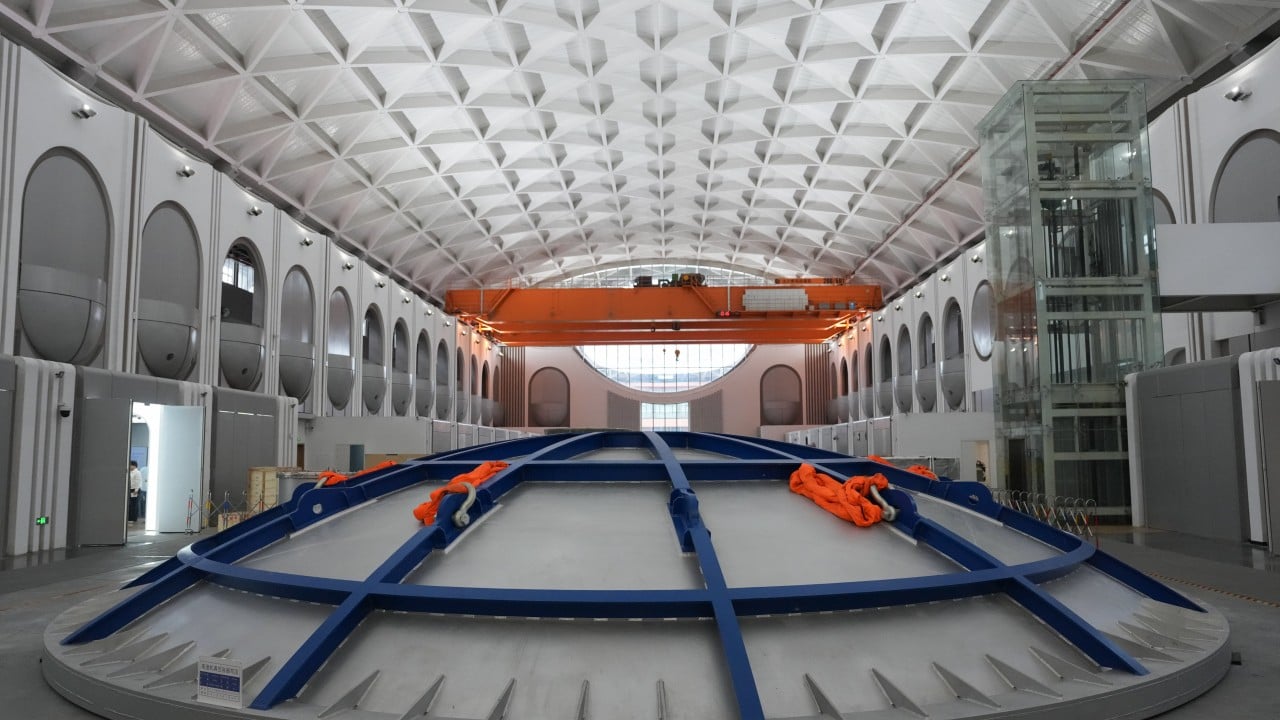
China is set to break its own record in hypergravity research with a colossal new centrifuge that can spin multi-tonne samples at unmatched intensities.
The machine, known as CHIEF1900, was built by Shanghai Electric Nuclear Power Group and shipped to Zhejiang University in eastern China on December 22 for installation. Once up and running, it will allow researchers to compress space and time, recreating catastrophic events such as dam failures and earthquakes inside a laboratory, according to the university.
With a capacity of 1,900 g·tonne – a unit that combines gravitational acceleration (g) and sample mass in tonnes – CHIEF1900 will become the most powerful centrifuge ever built for scientific research. It will surpass CHIEF1300, which came online in September, with a capacity of 1,300 g·tonne and holds the world record.
03:00
China launches Shenzhou-21 spacecraft with 4 mice aboard for 6-month experiment
China launches Shenzhou-21 spacecraft with 4 mice aboard for 6-month experiment
Both machines are part of the Centrifugal Hypergravity and Interdisciplinary Experiment Facility (CHIEF), a national laboratory 15 metres (49 feet) beneath the university campus to minimise vibration and ensure stable operation.
Advertisement
CHIEF1300 dethroned the long-time record holder operated by the US Army Corps of Engineers in Vicksburg, Mississippi, which has a capacity of around 1,200 g·tonne. That is in contrast to a household washing machine which rarely exceeds 2 g·tonne during a spin cycle.
Approved in 2021 with a budget of 2 billion yuan (US$285 million), the CHIEF complex is part of China’s broader effort to expand cutting-edge research infrastructure and promote international collaboration. The facility is open to users from universities, research institutes and industries – both domestic and overseas.
Advertisement
All objects on Earth are subject to gravity and the centrifugal force induced when spinning. By generating forces hundreds or thousands of times stronger than Earth’s gravity, machines such as CHIEF can compress time and distance, making it possible to study phenomena that would otherwise take decades or span kilometres, all within a lab.
For example, to assess the structural stability of a dam 300 metres (984 feet) tall, scientists can build a three-metre model and spin it at 100g. This replicates the same stress levels the full-scale dam would experience in the real world.