
Despite more than six decades of existence, the SEA Games continue to struggle with the image of an “ao làng,” or village pond—a colloquial Vietnamese term suggesting insularity and amateurism. Because the Games lack an independent governance mechanism and remain overly dependent on host countries, they suffer from persistent issues. These include refereeing controversies, arbitrary selection of competition events, maps that misrepresent national sovereignty, and even the withdrawal of national delegations.
Without reform, the SEA Games will continue to function as a largely symbolic, movement-style sporting event rather than evolving into a professional regional sports arena where international standards are upheld.
Why the SEA Games Fail to Professionalize
Nguyễn Hồng Minh, former head of the Việt Nam Sports Delegation, identified the root of this stagnation: “Many people call the SEA Games an ‘ao làng’ because the regional level is low and the scope is limited […] the organization of the SEA Games remains outdated, its regulations are insufficiently rigorous, and it depends heavily on each host country.” [1]
This assessment is reinforced by recent developments at the 33rd SEA Games. Despite being promoted as a platform for regional development, the event remains trapped in a cycle of localism, medal-driven ambition, and governance gaps tied to host nations.
The core issue is the lack of an independent, robust coordinating body similar to the Olympic Council of Asia (OCA) or the International Olympic Committee (IOC). Unlike the Olympic Games, each edition of the SEA Games is shaped almost entirely by the host country, from event selection to refereeing. Without a shared, binding rulebook, the event cannot evolve beyond ad hoc practices and narrow national interests.
Falling Short of a Truly “Regional” Competition
A notable example of this failure is Cambodia’s sudden decision to withdraw its entire sports delegation from the 33rd Southeast Asian Games hosted by Thailand, citing escalating border tensions. Vath Chamroeun, Secretary-General of the National Olympic Committee of Cambodia (NOCC), explained that the urgent recall was driven by safety issues, specifically “serious concerns and requests from the athletes’ families, who wanted their loved ones to return home immediately.” [2]
This incident exposes the vulnerability of the SEA Games to political and social fluctuations. In major arenas like the Asian Games or the Olympics, host nations are bound by professional security protocols and athlete protection mechanisms, making a mid-competition withdrawal on safety grounds almost inconceivable. By contrast, the SEA Games lack these binding standards, allowing a single destabilizing factor to unravel the event.
Ultimately, Cambodia’s decision to walk away lays bare the declining appeal of the SEA Games. It suggests that member countries view the event not as a professional sporting arena, but as a symbolic venue for exchange—one that is easily abandoned when an immature sporting ecosystem fails to guarantee safety.
A Series of Controversies and a Crisis of Trust
Beyond questions of competitiveness, the SEA Games face a crisis of trust stemming from systemic unfairness.
Host-country bias has long been embedded in the structure of the competition, ranging from manipulated event programs to biased officiating. A longstanding problem is the host’s ability to “pick-your-own-rules,” selectively choosing local sports or dropping events to maximize their medal count. [6] This skews the medal table to reflect regulatory maneuvering rather than the true caliber of athletes.
This bias extends to the field of play. From martial arts to gymnastics, officiating frequently favors the host. On Dec. 10, the Việt Nam and Philippines delegations simultaneously lodged complaints over a controversial decision in the mixed doubles poomsae taekwondo event at the 33rd SEA Games—an error visible to the naked eye. [3] Such incidents dishearten athletes and devalue the medals, which cease to be reliable indicators of excellence. When outcomes hinge on referees rather than performance, the Games inadvertently promote performative competition over sporting integrity.
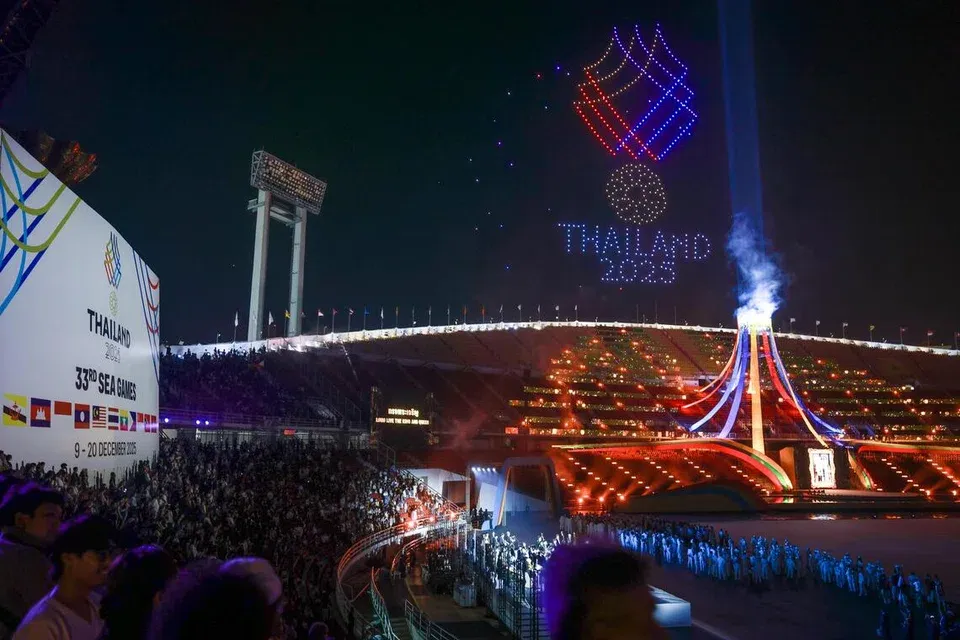
The crisis of trust is further compounded by organizational negligence regarding national sovereignty. One incident that sparked particular outrage among the Vietnamese public occurred during the opening ceremony of the 33rd SEA Games, when a map of Việt Nam was displayed without Phú Quốc Island and the Hoàng Sa and Trường Sa archipelagos. [4] Although Thai organizers dismissed it as a “technical error,” publishing maps that misrepresent sovereignty is a serious failure of due diligence. Such carelessness triggers diplomatic repercussions and public anger, turning a sporting event meant to bridge nations into a flashpoint for division. [5]
The Path Towards Systemic Change
Undeniably, Southeast Asia is not short on sporting talent. The problem lies not with the athletes’ abilities, but with the institutional structure of the SEA Games—a framework that is loose, inconsistent, and devoid of shared commitments. Without systemic change, no amount of investment will prevent regional performance from stagnating.
To escape the “ao làng” label, member countries must commit to serious reform. This requires standardizing events in line with the Olympic and Asian Games, implementing independent refereeing insulated from host influence, and strictly avoiding violations of territorial sovereignty.
However, participating countries have yet to demonstrate the resolve to pursue such change. If the region continues to tolerate a competition where rules are arbitrary, maps are incorrect, and safety is not guaranteed, the SEA Games will remain a largely ceremonial event.
Modernization can only occur when member nations place the collective interests of the region above short-term medal gains. A professional sporting architecture demands discipline and transparency—qualities that the SEA Games still lack.
Hải Bình wrote this article in Vietnamese and published it in Luật Khoa Magazine on Dec. 15, 2025. Đàm Vĩnh Hằng translated it into English for The Vietnamese Magazine.
- Phong, M. (2025, December 3). SEA Games 33 cần phá vỡ định kiến ao làng. Lao động. https://laodong.vn/the-thao/sea-games-33-can-pha-vo-dinh-kien-ao-lang-1619082.ldo
- CNA. (2025, December 10). Cambodia pulls out of 33rd SEA Games amid border conflict with Thailand, citing safety reasons. https://www.channelnewsasia.com/asia/cambodia-withdraws-sea-games-thailand-border-conflict-5571896
- Huy, N. (2025, December 10). Ký sự SEA Games 33: Việt Nam mất vàng và nước mắt vì trọng tài. Vietnamnet. https://vietnamnet.vn/viet-nam-hut-vang-sea-games-33-taekwondo-va-nuoc-mat-vi-trong-tai-2471237.html
- Đăng, H. (2025, December 10). Thái Lan đưa bản đồ Việt Nam thiếu Hoàng Sa, Trường Sa, báo Thái khẳng định ‘sai sót nghiêm trọng’. Tuổi Trẻ. https://tuoitre.vn/thai-lan-dua-ban-do-viet-nam-thieu-hoang-sa-truong-sa-bao-thai-khang-dinh-sai-sot-nghiem-trong-20251210050013185.htm
- Nam, Đ. (2025, December 10). Đoàn TTVN đề nghị làm rõ sai sót hình ảnh lãnh thổ ở SEA Games 33. Vietnamnet. https://vietnamnet.vn/doan-ttvn-de-nghi-lam-ro-sai-sot-hinh-anh-lanh-tho-o-sea-games-33-2471010.html
- Minh, D. (2020, July 19). Vì sao môn thi đấu SEA Games xáo trộn theo nước chủ nhà? Znews. https://znews.vn/vi-sao-mon-thi-dau-sea-games-xao-tron-theo-nuoc-chu-nha-post1108659.html