
Key Events
- Việt Nam Rushes Laws through its National Assembly under Fast-Tracked Procedures;
- New Press Law in Việt Nam Hands Police the Power to Demand Journalists to Disclose their Sources
- “False Reporting,” No Details: VietNamNet Penalized for Tô Lâm Story;
- New Cybersecurity Law Grants the Ministry of Public Security Authority to Identify Users by IP Address;
- At Việt Nam’s Request, Facebook Restricts Pages of Lê Trung Khoa, Nguyễn Văn Đài, and Việt Tân;
- Authorities Broaden Political Case, Moves to Arrest Former Government Official in Lê Trung Khoa Case
Việt Nam’s National Assembly Passes a Record Number of Laws this Session
Last week, in one session, nearly a third of an entire term’s laws were approved.
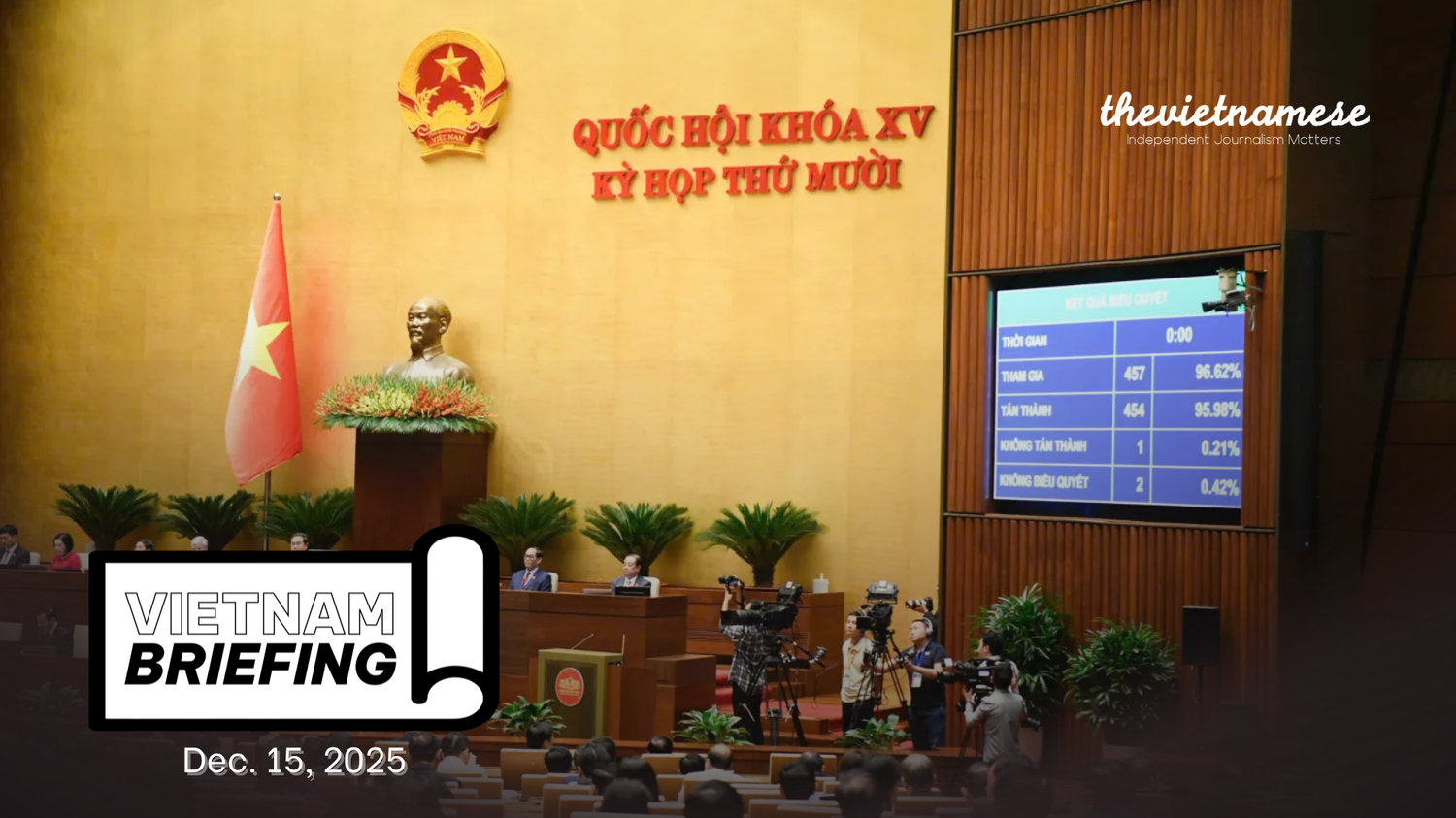
On the afternoon of Dec. 11, Việt Nam’s National Assembly closed its 10th session, which was the final session of its 15th term. Convened on Oct. 20 and lasting 40 days, the session passed a record number of legislative texts, accounting for roughly 30% of all legislation adopted during the entire term.
During this session, lawmakers approved 51 laws and 39 resolutions, including eight normative resolutions, exceeding the original targets set for the session.
Among the newly adopted or revised laws are several with far-reaching implications: the Amended Cybersecurity Law, Amended Press Law, Amended Law on the Execution of Criminal Judgments, Amended Law on the Execution of Civil Judgments, Amended Law on the Protection of State Secrets, as well as new laws on Extradition and Specialized Courts, among others.
In parallel, the National Assembly amended resolutions on special mechanisms for Hồ Chí Minh City (Resolution 98/2023) and Đà Nẵng (Resolution 136/2024), paving the way for ambitions to establish an International Financial Center. Lawmakers also expanded special powers for the chair of Hà Nội, including authority to reclaim land beyond the scope of the Land Law.
The session further reviewed 13 major groups of issues covering socio-economic development, the state budget, oversight activities, personnel matters under its authority, and other issues deemed nationally significant.
With only six months remaining in the term, the National Assembly approved the appointments of Phạm Thị Thanh Trà and Hồ Quốc Dũng as deputy prime ministers.
On the morning of Nov. 13, lawmakers passed a resolution on the 2026 socio-economic development plan, setting—for the first time—a target of GDP growth of 10% or higher in 2026, with GDP per capita projected at $5,400–$5,500 per year.
At least 50 of the 51 laws adopted during this session were passed under fast-track procedures and are scheduled to take effect on July 1, 2026. Under the Law on the Promulgation of Legal Normative Documents, laws passed through expedited procedures share three defining features:
- Significantly shortened drafting and public consultation periods;
- Eligibility for passage at the nearest National Assembly session, rather than over multiple sessions;
- The possibility of an immediate effect, instead of the standard minimum
On Oct. 14, National Assembly Chair Trần Thanh Mẫn publicly complained about pressure from the government to legislate at breakneck speed.
“At the very least, it takes three or five days,” he said. “We are not the Monkey King from Journey to the West, that others can send a draft in the afternoon and expect us to study it and vote the next day. That is simply impossible.”
The remark spread quickly online and was subsequently removed from Thanh Niên newspaper.
Vietnam’s National Assembly is frequently described by experts and observers as a “rubber-stamp legislature” within the one-party system. Notably, this session also eliminated live questioning and interpellation, replacing it with written questions. The last time direct questioning was suspended was in April–May 2020, during the COVID-19 pandemic.
General elections for the next National Assembly are scheduled for March 15, 2026, with the new legislature set to convene within 60 days thereafter. Quiet preparations for the elections have already been underway since early December.
National Assembly Amends Press Law, Grants Police Power to Compel Journalists to Reveal Sources
The 2025 amended Press Law continues to expand the powers of the Ministry of Public Security (MPS) and further constricts press freedom in Việt Nam.
On the morning of Dec. 10, Việt Nam’s National Assembly passed the amended Press Law, which will take effect on July 1, 2026. Several provisions will come into force earlier, on Jan. 1, 2026.
This amendment grants broader authority to the MPS by allowing heads of investigative agencies to demand that press organizations and journalists disclose their sources to “serve investigation, prosecution, and adjudication.” At present, this authority rests with the procuracy and the courts.
In addition, social media channels run by news organizations—including Facebook, YouTube, and TikTok—will now be regulated more tightly, similar to traditional media formats such as print and online newspapers.
Media outlets must comply with regulations prohibiting the publication of “banned information.” The government will issue further directives to define these categories. Published content must also be archived for potential investigation by the Ministry of Public Security.
State regulators, directly the MPS, may demand the immediate removal of information deemed unlawful, without any complaint or appeal procedure.
As of Dec. 11, the National Assembly and relevant state agencies had not yet released the full text of the amended Press Law. The most recent publicly accessible version remains the draft circulated in February for public consultation.
Press freedom in Việt Nam has seen little improvement over the years.The country currently ranks 173rd out of 180 in the World Press Freedom Index by Reporters Without Borders (RSF).
The Communist Party is carrying out an unprecedented restructuring of the state-run press system under the 2025 Press Planning Scheme, alongside an administrative streamlining effort earlier this year that led to numerous outlets shutting down or merging.
The amendments will make it “virtually impossible for journalists to report freely,” in Việt Nam, said Aleksandra Bielakowska of RSF.
Patricia Gossman, deputy Asia director at Human Rights Watch, added that the law marks “the latest step in an ongoing crackdown on dissent and press freedom” in Việt Nam.
Several international commentators have even likened the country to “the world’s third-largest prison” for independent journalists, noting that around 40 journalists and bloggers are being held behind bars.
Foreign reporters seeking to work in Việt Nam also face tight supervision, travel-approval requirements, and restricted access to domestic media events.
VietNamNet Fined for “False Reporting” on Tô Lâm, Details of Violations Withheld
On the afternoon of Dec. 8, the Authority of Press from the Ministry of Culture, Sports and Tourism, announced an administrative fine of 65 million đồng ($2,480) against VietNamNet online newspaper, citing two violations in a decision dated Dec. 1. Specifically:
- A 60 million đồng fine for “publishing false information causing serious impact” in the article “General Secretary Tô Lâm orders a complete shift from the mindset ‘Hà Nội cannot be rushed,’” published on Oct. 16, 2025.
- A 5 million đồng fine for “using an illustration inconsistent with the article’s content, causing readers to misunderstand [the construction’s purpose]” in “A strange emptiness at Đông Kinh Nghĩa Thục Square after the ‘Shark Jaw’ structure was dismantled,” published on Sept. 9, 2025.
The Authority of Press did not release the full penalty decision nor provide details explaining what, exactly, was false or improperly illustrated.
The first article now carries a new title — “General Secretary: Hà Nội must radically change its mindset with a ‘say it, do it’ spirit.” VietNamNet issued a correction and apology on Oct. 22.
It remains unclear which image in the Đông Kinh Nghĩa Thục Square article was considered inappropriate; the piece is still online with the original headline.
This is not the first time VietNamNet has been penalized:
- In 2018, the outlet was fined 50 million đồng for “false reporting” on President Trần Đại Quang’s remarks about a draft law on demonstrations, and was required to issue a correction and apology.
- In 2024, it was fined 7.5 million đồng for inaccurate reporting on one student’s math exam score.
In recent years, the Authority of Press has escalated administrative sanctions across the media landscape.
- The Environmental Economics Magazine was fined 77.75 million đồng in January 2025;
- Tri Thức & Cuộc Sống received a 7.5 million đồng fine in February 2025;
- The editor-in-chief of Rural Enterprise & Brand Magazine was fined 7.5 million đồng in March 2024.
A draft amended Press Law currently before the National Assembly explicitly reinforces the role of “revolutionary journalism” and maintains restrictions on press freedom, including the obligation to safeguard the Communist Party’s viewpoints and political line.
Vietnam ranks 174th out of 180 countries in 2024 and 173rd in 2025 on the World Press Freedom Index compiled by Reporters Without Borders; it has previously been as low as 178th. In 2023, PEN America classified Vietnam among the world’s top three jailers of journalists.
On the morning of Dec. 10, Việt Nam’s National Assembly passed a new Cybersecurity Law, under which the MPS will take on the role of managing internet identification addresses (IP) across cyberspace.
The 2025 Cybersecurity Law will take effect on July 1, 2026.
This legislation was drafted by merging the 2018 Cybersecurity Law and the 2015 Cyberinformation Safety Law.
Under the new framework, the MPS becomes the sole authority with full power over state management of cybersecurity.
Notably, the ministry will take responsibility for developing mechanisms to identify IP addresses and verify registration information for digital accounts. On that basis, it will directly manage and monitor internet users through IP address identification.
Minister of the MPS Lương Tam Quang explained that cybersecurity operations are intended to “combat and prevent cybercrime,” in which information sharing and data-based evidence collection play a crucial role.
The ministry says mandatory IP identification is necessary due to gaps in network-management infrastructure and various obstacles that currently prevent authorities from verifying user identity, hindering investigations and the handling of violations online. “An IP address is a tool to identify the user of a network-connected device,” the ministry’s representative emphasized.
Additionally, MPS authorities will have the power to request domestic and foreign telecommunications service providers to remove information deemed harmful to national security and to hand over user data upon request.
Throughout 2025, Việt Nam continues to enforce broad information controls on social media, repeatedly issuing fines and removal orders against citizens who share content deemed contrary to the government’s position.
Freedom House, in its latest report, again classified Việt Nam as “Not Free,” giving the country an overall internet freedom score of 22/100, including a privacy rights score of 4/40. The report notes that authorities maintain strict censorship and deploy technical measures to block, filter, or remove online content.
Alongside the 2025 Cybersecurity Law, the government previously issued Decree 147 (effective Dec. 24, 2024), requiring social media users to verify their accounts using phone numbers and other identification documents. The law also mandates that social media platforms must take down content deemed “illegal” within 24 hours of a government request.
According to AP News, an international observer views these developments as part of Việt Nam’s “efforts to stifle freedom of expression.” Analysts point out that most Vietnamese citizens obtain information from social media; the government can censor and block sources outside Việt Nam that it does not want to appear in domestic media.
Facebook Blocks Pages of Lê Trung Khoa, Nguyễn Văn Đài, and Việt Tân Party in Việt Nam at Government Request
Facebook has blocked access in Việt Nam to the pages of prominent dissidents Lê Trung Khoa and Nguyễn Văn Đài, as well as the opposition party Việt Tân — a major escalation targeting some of the largest platforms in the country’s pro-democracy community. Users inside Việt Nam can no longer view their pages without a VPN.
On Dec. 5, both Khoa and Đài announced that their Facebook pages had been restricted in Việt Nam following a request from the Ministry of Public Security. On Dec. 6 , Việt Tân confirmed that its page was also inaccessible inside the country.
Around the same time, Meta said it had temporarily blocked 17 pages in Việt Nam at the request of the Ministry of Public Security and the Ministry of Culture, Sports, and Tourism. Users outside Việt Nam — or inside Việt Nam using a VPN — can still access the content.
From Dec. 5–8, Luật Khoa Magazine verified that the pages of Lê Trung Khoa, thoibao.de, Nguyễn Văn Đài, and Việt Tân (with 475,000, 1.3 million, 931,000, and 2 million followers respectively) all displayed the notice: “This content is not available in your country.”
Việt Tân spokesperson Dr. Đông Xuyến told Luật Khoa the block was issued under an order from the Ministry of Culture, Sports, and Tourism. She noted this is the first time their entire page has been fully blocked, though individual posts had previously been removed.
Meta stated on its website that failure to comply with local legal demands could subject the company to penalties and affect access to Meta services in Việt Nam, particularly ahead of the upcoming 14th National Congress of the Communist Party, because this is the time the party tries to stabilize the political situation in the country.
Khoa and Đài are dissidents based in Germany. Việt Tân, headquartered in the U.S., is designated a “terrorist organization” by the Vietnamese government, a classification Việt Tân strongly rejects.
On Nov. 18, MPS charged both men in absentia and in separate cases under Article 117 for “making, storing, disseminating, or propagandizing against the state.” On Dec. 5, arrest warrants were issued for them.
On Dec. 6, authorities expanded the same investigation and issued warrants for Phạm Quang Thiện, a former senior official in the Government Office’s multimedia center.
These moves come just before the 15th Central Committee plenum, which is expected to determine key leadership positions for the next party term.
On Dec. 5, Lê Trung Khoa told Luật Khoa that his pages had never been blocked in Việt Nam before, calling it “an extreme escalation” of repression targeting independent voices abroad and a violation of the government’s stated commitments on press freedom. He criticized Facebook for complying, arguing that foreign companies cooperate with the government in Việt Nam while citizens and their users face significant political risk.
Dr. Đông Xuyến said Việt Tân has asked Meta for greater transparency, noting that the decision affects an entire political community. “This is not a technical action,” she said. “It reflects a painful reality: Vietnamese citizens’ access to information is shrinking, and state control over social media is tightening.”
Responding to both the block and his wanted notice, Đài told Luật Khoa that he will “absolutely continue [his] activism,” though he will diversify activities beyond media work. Đài noted that only his public Facebook page (“Nguyễn Văn Đài”) is blocked; his personal profile remains accessible. Đông Xuyến added that Việt Tân does not depend on any single platform.
Luật Khoa Magazine contacted the MPS through its official website on Dec. 5, but as of the afternoon of Dec. 8 had received no reply. Meta has also not responded to interview requests sent on Dec. 5.
Ministry of Public Security (MPS) Widens Lê Trung Khoa Case, Moves to Arrest Ex-Government Official Phạm Quang Thiện
On Dec. 6, the MPS announced that it had issued an indictment and a pre-trial detention order for Phạm Quang Thiện, in connection with the political case involving journalist Lê Trung Khoa.
Thiện is the former director of the Center for Technology and Multimedia Communication under the government’s Electronic Information Portal — a management-level position within the Government Office.
A document dated Dec. 20, 2024, found by Luật Khoa on the government website chinhphu.vn, listed Thiện among nominees for a 2024 government commendation.
Thiện is being investigated under Article 117 of the Penal Code for “making, storing, disseminating, or propagandizing information and materials against the Socialist Republic of Việt Nam,” as authorities expand their probe into the Lê Trung Khoa case.
The MPS said the Supreme People’s Procuracy has approved the indictment, detention order, and search warrant for Thiện.
This marks the latest development in the Lê Trung Khoa case, unfolding just ahead of the Communist Party’s 15th Central Committee meeting and the 14th Party Congress (Jan. 19–25, 2026).
Khoa and his outlet Thoibao.de frequently publish alleged “internal information” about party power struggles, though their sources remain unknown. Police opened the case on Nov. 18 and issued a warrant for Khoa on Dec. 5. Another individual in the same case, Đỗ Văn Ngà, has also been indicted. Lê Trung Khoa holds dual German–Vietnamese nationality and resides in Berlin.
Although headlines from state media and the MPS used the phrase “tạm giam” (temporary detention), the official statements only confirm that an order for detention was issued — not that Thiện has actually been taken into custody.
The photo used in state media shows Thiện against a sky-blue fabric backdrop — typical of ID documents, not arrest-related imagery. Luật Khoa has not yet been able to verify whether Thiện has in fact been detained.
Quick Takes:
The Vietnamese authorities have remained silent on the whereabouts and legal status of Montagnard activist Y Quỳnh B’Đăp since Thailand announced on Nov. 28 that he had been handed over to Vietnam, just two days after his appeal hearing. On Dec. 8, international human rights groups and his lawyers demanded that Vietnam disclose his location, health situation, and detention status, warning of risks of torture or enforced disappearance. No information has been provided to his family or legal representatives. B’Đăp has a long history of being persecuted for indigenous rights advocacy and was sentenced in absentia in 2023. The silence has intensified international concern.
Hà Nội Court to Try Lê Trung Khoa and Nguyễn Văn Đài on December 31
The Hà Nội People’s Court will hold first-instance trials for dissidents Lê Trung Khoa and Nguyễn Văn Đài on Dec. 31, charging both under Article 117 of the Penal Code for disseminating anti-state information, according to VnExpress. The cases have moved from investigation to trial in under two months—an unusually rapid pace for political prosecutions. Authorities opened investigations in early November, issued indictments in early December, and are proceeding to prosecute the cases in absentia as both defendants reside in Germany. Prosecutors also indicted three additional defendants in Khoa’s case. The trials come as the Communist Party prepares for the 15th Central Committee plenum, amid heightened scrutiny of dissent.
Tây Ninh Detention Center Blocks Lawyer’s Visit to Death-Row Inmate Hồ Duy Hải
A detention center in Tây Ninh has refused to allow lawyer Ngô Ngọc Trai to meet death-row inmate Hồ Duy Hải, citing a lack of authority to approve lawyer-client visits. In a letter dated Nov. 4, Detention Center No. 2 under the provincial police denied Trai’s request, a decision he confirmed on Dec. 9. Trai disputes the interpretation, arguing the authority lies with the warden and calling for legal reforms to guarantee access to counsel for condemned prisoners. Hồ Duy Hải’s case, marked by disputed evidence and a halted execution in 2014, remains one of Vietnam’s most controversial death penalty cases.
National Assembly Approves Specialized Courts Law, Allowing Foreign Judges to Serve in Việt Nam
Vietnam’s National Assembly on Dec. 11 approved the Law on Specialized Courts at the International Financial Center, marking the first legislation of its kind and allowing foreign judges to serve in Vietnam. Passed with 438 of 444 votes, the law takes effect on Jan. 1, 2026, and places the specialized court within the people’s court system, with jurisdiction over disputes arising in international financial centers. Foreign judges must meet strict professional and ethical requirements. The vote follows a Politburo decision endorsing the model as part of Vietnam’s strategy to develop free trade zones and international financial hubs. Several procedural issues remain to be clarified in future regulations.
Party Media Silent on 15th Central Committee Meeting Amid Surge of Rumors
State and party media in Việt Nam were silent on Monday, Dec. 8, amid intensifying online speculation over the timing and personnel outcomes of the Communist Party’s 15th Central Committee meeting. The plenum is expected to decide the leadership “five pillars,” including the general secretary and prime minister, ahead of the party’s 14th National Congress in January 2026. Instead of addressing the meeting, official outlets reported senior leaders attending unrelated events in Cần Thơ and Tây Ninh. No date for the plenum has been announced. The information blackout coincides with a widening crackdown on political commentary, including the blocking of Thoibao.de and new arrest warrants tied to its editor.
Việt Nam’s 2026–2030 election cycle has quietly begun as provinces nationwide completed the first round of hiệp thươngcandidate vetting from Dec. 1–10. Major cities, including Hà Nội, Hồ Chí Minh City, Đà Nẵng, and Cần Thơ, convened meetings to shape the initial pool for the 16th National Assembly and local People’s Councils. In Hồ Chí Minh City, the authorities nominated 55 candidates for 38 seats, citing compliance with pre-set structures. The hiệp thương process—three rounds led by the Fatherland Front—effectively controls who may run. Independent candidates face steep barriers, reflecting Việt Nam’s tightly managed one-party electoral system.
Việt Nam’s Deputy Defense Minister Visits Japan Despite Sexual Harassment Allegations
Deputy Defense Minister Senior Lt. Gen. Hoàng Xuân Chiến led a Vietnamese delegation to Japan on Dec. 4 for the first Vice-Ministerial Diplomatic–Defense Dialogue, despite unresolved sexual harassment allegations raised by South Korea more than two months earlier. In Tokyo, Chiến outlined priorities for bilateral defense cooperation, including military exchanges, personnel training, and Japanese support for post-war remediation. South Korean media reported that Chiến inappropriately touched a female civil servant in Seoul on Sept. 11, prompting a formal protest from Seoul’s defense ministry. The Vietnamese authorities have issued no public response. Chiến has continued official duties, reflecting a pattern of silence surrounding similar allegations involving Vietnamese officials abroad.
New Personal Income Tax Law Imposes 5% Rate on Monthly Taxable Income Up to 10 Million Đồng
Vietnam’s National Assembly on Dec. 10 passed an amended Personal Income Tax Law, raising the 5% tax threshold on monthly taxable income from 5 million to 10 million đồng. Effective July 1, 2026, the law reduces tax brackets to five tiers, with the highest rate of 35% applying to income above 100 million đồng per month. Family deductions will rise to 15.5 million đồng per taxpayer and 6.2 million per dependent. The Ministry of Finance says the changes benefit middle-income earners but will cut annual revenue by about 21 trillion đồng. Some experts warn that the top rate remains too low-threshold and uncompetitive.
Japan Withdraws From Việt Nam’s Nuclear Power Project
Japan has withdrawn from Việt Nam’s Ninh Thuận 2 nuclear power plant project due to an overly compressed implementation timeline, according to Reuters on Dec. 8. Japanese Ambassador Naoki Ito said Tokyo was “not in a suitable position” to proceed under Hà Nội’s schedule, with the decision made in November. Vietnamese media have not reported the withdrawal. The move complicates Việt Nam’s revived nuclear plans as the country faces growing electricity shortages and delays in renewable and gas projects. Japan’s exit comes amid rising energy demand and heavy reliance on imported coal, which currently supplies more than half of Việt Nam’s electricity.