

[The content of this article has been produced by our advertising partner.]
Aligning with the latest direction of I&T development outlined in the Chief Executive’s Policy Address – which calls for accelerating AI advancement alongside the development of the Northern Metropolis and the Hetao Shenzhen-Hong Kong Science and Technology Innovation Co-operation Zone (the Loop) – ASTRI has intensified its push for AI+ applications. This initiative integrates AI with patented technologies across fields such as the Internet of Things (IoT), robotics, chips, imaging, and application-specific integrated circuits, delivering practical solutions for real-world challenges.

ASTRI aims to leverage its role to drive cross-border innovation in AI, manufacturing, and digital health, while accelerating commercialisation through strengthened IP (intellectual property) transfer, industry partnerships, and flexible licensing models.
Advertisement
At the heart of ASTRI’s vision is the creation of a “Cognitive City,” characterised by sustainability, resilience, and human-centricity. Building on the foundation of a “Smart City,” Suen says: “The future is uncertain. We cannot afford to react; we must anticipate. Innovation is our compass. It gives us foresight and the courage to experiment.”
A Cognitive City, as envisaged by Suen, fosters trust by ensuring citizens have clear visibility into who holds their data and how they benefit from sharing it. “It integrates IoT data across multiple sources for holistic intelligence. It uses AI not just to optimise, but to analyse and learn across systems, enabling proactive and autonomous decisions,” he says. “Instead of alerts, it delivers real-time recommendations with speed and reliability, anticipating needs before they arise. This shift – from reactive to predictive, proactive, and autonomous – is what will define the cities of tomorrow.”
Advertisement
Because a Cognitive City demands technological convergence, AI must be integrated across systems. “We call this AI+, in which AI is combined with IoT, robotics, chips, imaging, and more,” Suen adds. “It’s vital because no single technology can solve the complexity of urban challenges. It’s the synergy that creates transformation.”
AI+ is central to ASTRI’s strategy, with applications spanning healthcare, finance, and smart cities. “In healthcare, we’re advancing AI for diagnostics, medical imaging, and the Internet of Medical Things to improve patient outcomes. In finance, we’re developing AI solutions like large language models tailored for compliance, fraud detection, and customer service enhancements. For smart mobility, we’re pioneering technologies such as Cellular Vehicle-to-Everything (C-V2X) for connected vehicles, smart traffic systems, and AI-driven infrastructure monitoring.”
Since its establishment in 2000, ASTRI has remained at the forefront of I&T, successfully transferring about 1,600 technologies to industries – demonstrating its ability to transform research into real-world solutions. It has secured nearly 1,200 patents globally. Notably, ASTRI is the only R&D institution based in Hong Kong to be ranked among the Top 60 global non-profit research institutions and government agencies for granted US utility patents in 2024, placing 42nd with 27 patents.
Advertisement
Unique strengths
ASTRI’s core strengths lie in its ability to integrate leading-edge technologies – including AI, IoT, communications, microelectronics, and robotics – to develop tailor-made practical solutions. With a sharp focus on applied research, it specialises in applications and commercialisation, distinguishing itself from universities and other research organisations.
Its leadership in IP – through high-quality patents and proven expertise in technology transfer – accelerates the journey from lab to market. ASTRI’s core R&D competence in various areas is grouped under five Technology Divisions: Advanced Electronic Components and Systems; Artificial Intelligence and Trust Technologies; Communications Technologies; IoT Sensing and AI Technologies; and Intelligent Perception and Control Technologies. “Our R&D excellence comes from world-class researchers and engineers delivering cutting-edge innovations. We play a unique super-connector role, positioned to link Chinese Mainland, the GBA, and international markets, fostering cross-border innovation,” Suen says.
Advertisement
ASTRI’s edge in IP commercialisation bridges the gap between R&D and market adoption. “We achieve this through close partnerships with industry stakeholders. Flexible licensing models and tailored agreements ensure our partners can maximise the value of our technologies. Our collaborations with private enterprises, public bodies, and universities drive technology adoption and real-world impact.” Suen notes. “Our IP strategy ensures that innovations are protected, commercialised, and scalable, contributing to both industrial upgrades and economic growth.”
A role in China’s I&T advancement
China’s 15th Five-Year Plan sets out a vision of transformation, aiming to achieve high-quality development and strengthen self-reliance in science and technology. At the heart of this strategy is a shift toward a more sophisticated, innovation-driven model. The plan emphasises moving the economy up the value chain by digitising, automating, and greening traditional industries, while fostering advanced manufacturing, high-end technology, and modern services as new engines of growth.
Advertisement
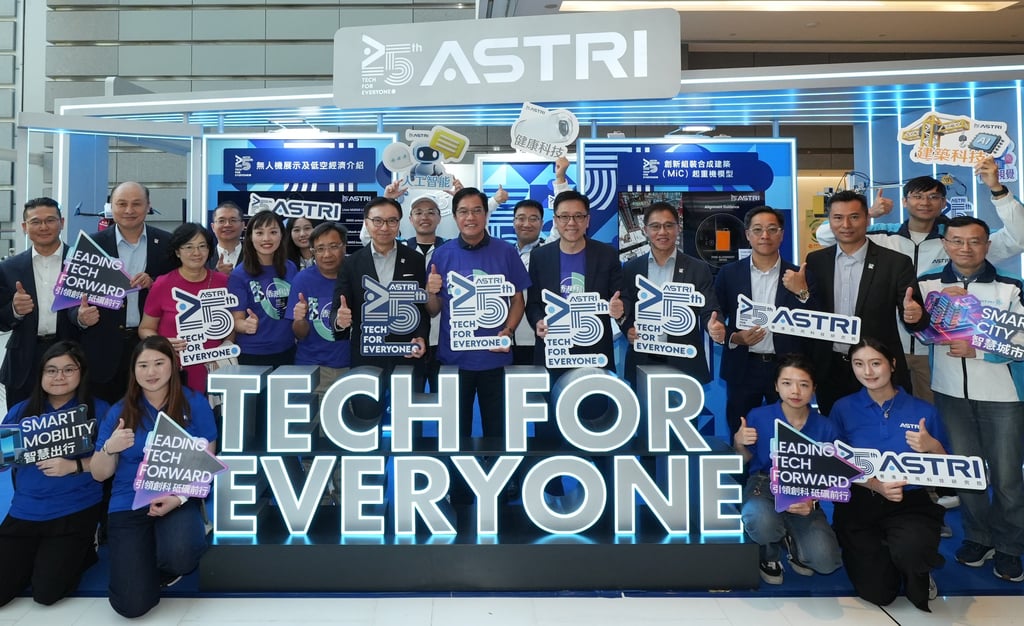
ASTRI’s commitment to advancing national technology is evident in its strategic focus on emerging sectors. “We prioritise R&D in smart mobility, green energy, AI healthcare, and advanced manufacturing, while also investing in talent development initiatives such as the PhD work-study programme and summer internships to nurture world-class expertise,” Suen says. “By deepening global collaborations with Chinese Mainland and overseas stakeholders, we aim to establish ourselves as a leading force in contributing to Hong Kong’s position as an international innovation and technology hub.”
Advertisement