
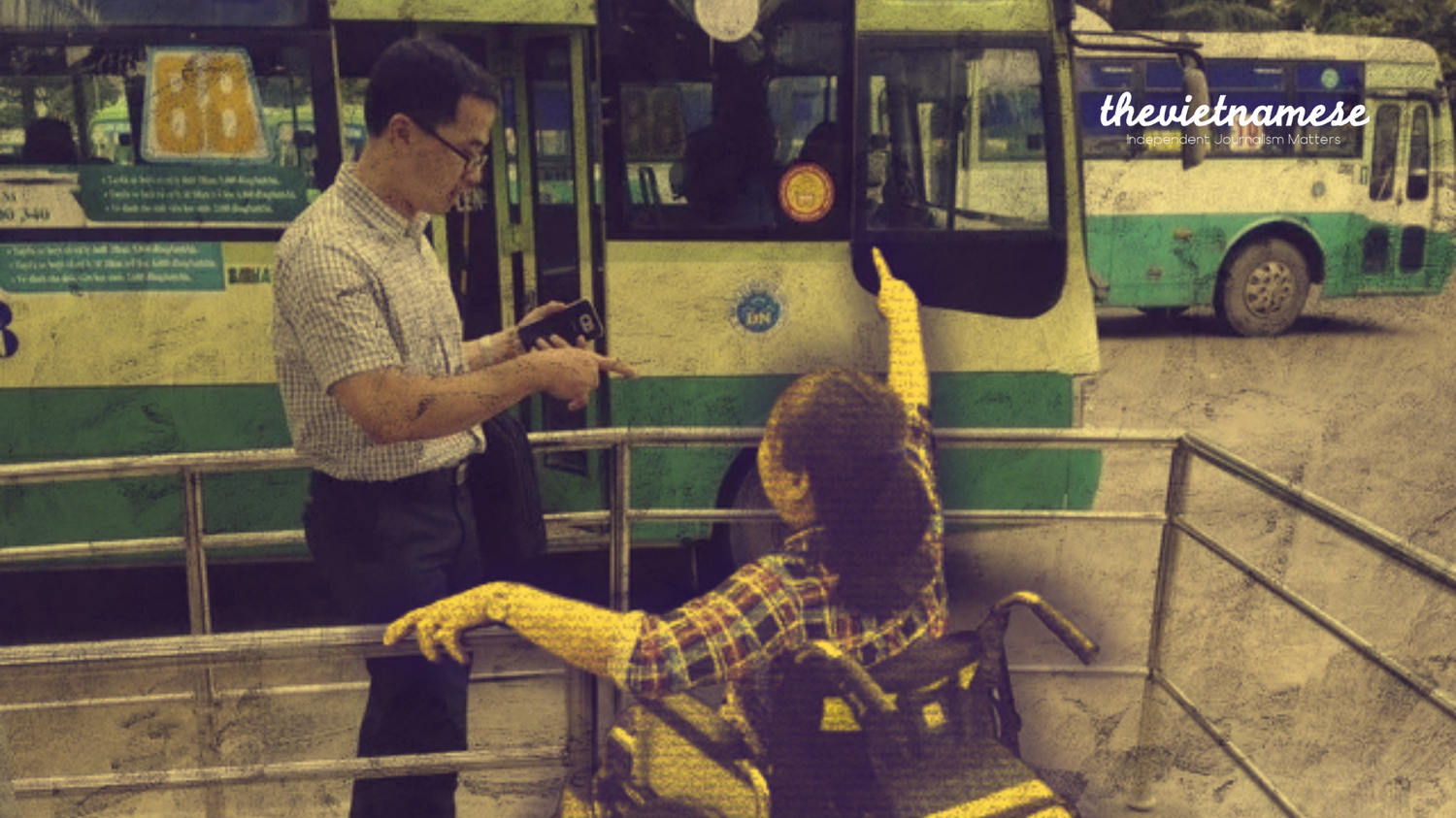
On a weekday morning in Hà Nội, a wheelchair user faces a curb nearly the height of his knees. Although a ramp exists, the incline is so steep that the wheels slide backward with every push. Glancing at the relentless stream of motorbikes below, he eventually abandons the trip. The distance was barely 150 meters, yet for him and many others in the city, it was insurmountable.
Such scenes echo across Việt Nam’s fast-growing urban centers, defining the daily reality for millions of people—from disabled residents and older adults to parents with strollers. Despite the country’s rapid economic development and modernizing skyline, accessibility remains one of the most overlooked dimensions of urban life.
This raises several uncomfortable questions: Why do contemporary cities, built to signal progress, still leave so many behind? And what does this reveal about whose needs are respected, and whose are ignored, in the design of Việt Nam’s public spaces?
Việt Nam’s Rapid Urbanization Leaves Millions Behind
Accessibility is frequently dismissed as a niche concern, yet global data suggests otherwise. According to the World Health Organization, an estimated 16% of the world’s population lives with some form of disability, including mobility, visual, auditory, or cognitive impairments. In Việt Nam, the Ministry of Labour, Invalids and Social Affairs reports that roughly 7.8% of the population are officially recognized as persons with disabilities. The actual figure is likely higher when factoring in older adults and those with temporary impairments.
This demographic reality collides with the fact that Việt Nam is urbanizing at one of the fastest rates in East Asia. The World Bank notes that the country’s urban population has grown from under 20% in 1990 to around 40% today. While this has reshaped cities at unprecedented speed, infrastructure expansion has not been matched by improvements in accessibility. The pace of construction has simply outstripped the pace of inclusive design.
Research from the International Labour Organization also links accessible environments to higher workforce participation and stronger economic resilience. Consequently, an inaccessible city does not just hinder its disabled residents; it quietly impoverishes itself.
Despite improvements in Việt Nam’s urban landscape, barriers restricting disabled people remain embedded in ordinary, everyday spaces. Familiarity makes them easy to overlook, yet they function as effective walls against participation.
The disconnect is most obvious in physical infrastructure.The most visible obstacles are the sidewalks themselves. In many cities, curbs are high, uneven, or interrupted by sudden drops. Ramps exist, but many are built at inclines far steeper than what wheelchair users can safely navigate.
In dense commercial neighborhoods, sidewalks are often blocked by parked motorbikes or street vendors, pushing anyone with limited mobility into active traffic lanes. These issues are commonly cited across Asia, where inaccessible pedestrian environments disproportionately affect disabled residents, older adults, and caregivers using strollers.
Public transportation poses another layer of difficulty. According to the United Nations Economic and Social Commission for Asia and the Pacific (ESCAP), gaps in transit infrastructure remain a major barrier across the region. In Việt Nam, most buses lack low-floor access, and while new metro lines feature elevators, the connections to nearby streets are often broken.
Public buildings reveal a similar divide. While major shopping malls and newly built commercial complexes increasingly provide accessible restrooms, many district-level hospitals, administrative offices, intercity bus stations, and outdoor public facilities still lack fully accessible designs. For people who rely on mobility aids, these gaps can make even routine errands unexpectedly difficult.
The digital space also presents barriers. Global audits reveal that public-service platforms frequently fail basic accessibility tests. The 2025 WebAIM Million report found that 94.8% of the world’s top one million homepages contained at least one WCAG 2 violation. Without the active adoption of Web Content Accessibility Guidelines (WCAG), essential information remains locked away from many disabled users.
These obstacles form the baseline of daily life. Because they are so pervasive, they determine who is welcomed into the city and who is quietly pushed to the sidelines.
Why These Barriers Persist
Many of the obstacles disabled residents encounter are not the result of intentional exclusion. They stem from design assumptions, technical gaps, and the rapid pace of urban development—factors that quietly shape who can move through a city and who cannot.
Urban design often begins with an “able-bodied default.” City planners frequently design for a theoretical user with full mobility, vision, and balance. This default shapes countless design decisions: sidewalk heights, curb cuts, ramp angles, and the spacing of public furniture. The result is infrastructure that may look orderly but remains difficult—or impossible—to use for anyone outside that narrow frame. A growing body of research on universal and inclusive design has documented this pattern, showing that public spaces built without accessibility standards routinely exclude disabled people. Organizations such as UN-Habitat now frame inclusive planning as a core condition for equitable cities. where feedback from disabled residents is standard, Việt Nam rarely tests public works with the people who need them most.
Even where technical standards exist, implementation is inconsistent. Việt Nam has national guidelines for accessibility—including standards for ramps, corridors, and entrances—but they are not uniformly applied. Ramps added “for compliance” frequently exceed safe inclines, failing to meet international recommendations like the U.S. Access Board’s 1:12 gradient.
User consultation is also limited. In Organisation for Economic Co-operation and Development (OECD) countries, accessibility planning often includes structured feedback from disabled residents. This helps identify real-world obstacles that technical drawings overlook. In Việt Nam, such consultation is still emerging, and many public works are approved without being tested by the people who will rely on them most.
Rapid urbanization compounds these gaps. Việt Nam’s cities expand quickly, sometimes faster than regulatory systems can monitor design quality. When timelines are tight, accessibility becomes one of the first elements sacrificed—quietly, and often unintentionally.
Practical and Achievable Steps Toward Inclusion
Improving accessibility does not require dramatic overhauls. Many of the most effective solutions are technical, affordable, and already well documented in international practice.
Sidewalks and ramps are a natural starting point. Simple measures—such as ensuring ramp gradients remain below the commonly recommended 1:12 ratio (U.S. Access Board ADA Guidelines), maintaining continuous sidewalks without abrupt drops, and installing tactile paving for blind or low-vision pedestrians—can significantly expand who can move safely through the city.
Public transportation can also become more inclusive with incremental upgrades. Low-floor buses, accessible bus stops with gentle ramps, and clear audio-visual announcements help create a system that accommodates a wider range of riders. Cities across Asia have adopted these standards gradually, demonstrating that accessibility does not depend on perfect infrastructure—only on consistent attention to user needs.
Public infrastructure follows the same logic. Features such as accessible restrooms, widened doorways, and unobstructed corridors are standard in many countries and increasingly common in Việt Nam’s newer developments. Extending these features to district-level hospitals, administrative offices, and outdoor public facilities would reduce the hidden barriers that deter many people from seeking services or participating fully in community life.
Digital spaces are equally important. Government portals and essential services can adopt the Web Content Accessibility Guidelines (WCAG), ensuring that screen-reader users or those needing larger text can navigate information without difficulty. Digital accessibility often costs little but yields substantial gains in independence and inclusion.
Finally, involving users directly can transform outcomes. Testing new construction with wheelchair users, blind pedestrians, or people with limited mobility identifies problems that technical drawings overlook. This “design from the ground up” approach is standard in many OECD countries and can be adapted easily in Việt Nam.
These solutions are neither political nor ideological. They reflect a simple principle: cities function best when they are built for everyone.
Conclusion
Accessibility should not be viewed as a special accommodation for a minority. It is the foundation of a humane and modern city—one that recognizes the full range of bodies, ages, and abilities that move through it every day. When urban spaces are designed to be inclusive, the first beneficiaries are often those who struggle the most, but the ultimate beneficiary is the city itself.
A smooth sidewalk or a low-floor bus may seem like small details. Yet for someone who relies on a wheelchair, a cane, or a caregiver, these details can determine whether a simple trip is possible at all. They define a person’s confidence, autonomy, and dignity.
A city that sees all its residents—visibly and invisibly—is a city that becomes stronger, fairer, and more compassionate.