
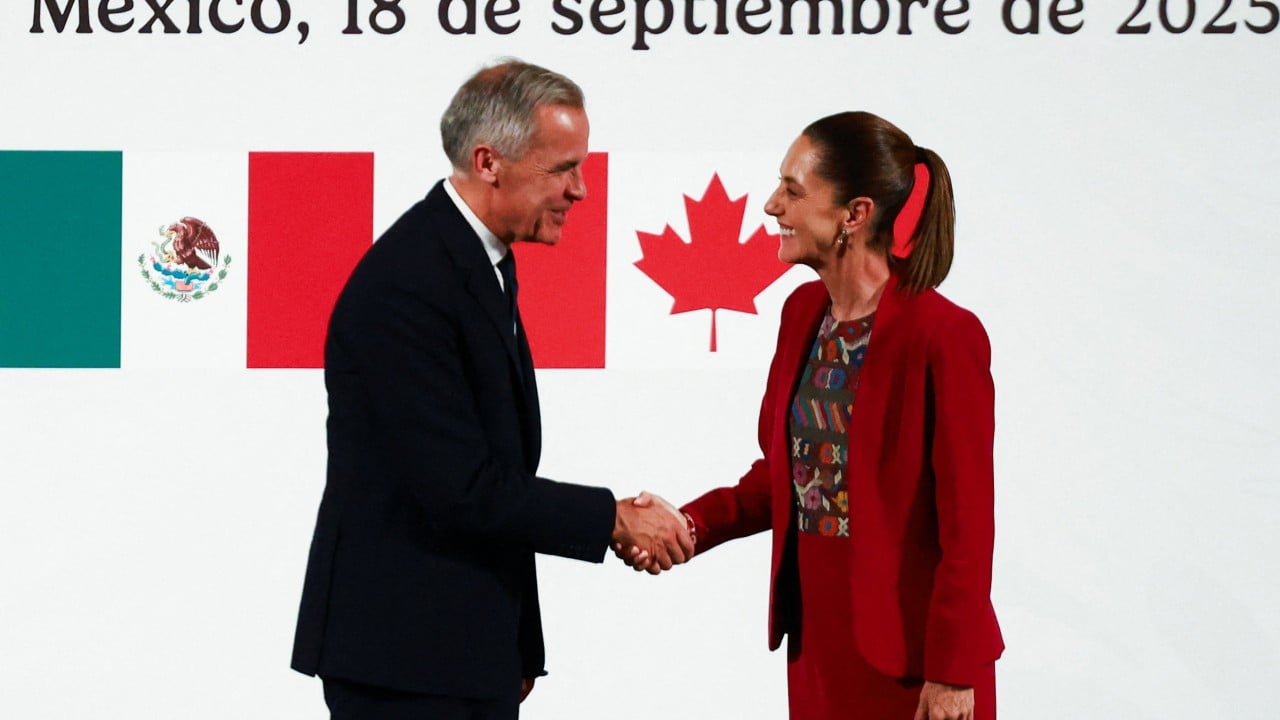
“We will move forwards together,” Canadian Prime Minister Mark Carney declared in Mexico, where he pushed for a new era of bilateral cooperation between America’s two immediate neighbours.
Advertisement
Carney, who met Mexican President Claudia Sheinbaum, added: “I have full confidence, and so does the president, that we can find the adjustments needed to reinforce competition and competitiveness in our region.” This was the first visit in eight years by a Canadian leader to Mexico City, underscoring the renewed sense of urgency among US allies.
Massive dependence on a single neighbour is a serious problem for both sides. Around 80 per cent of Canada’s and Mexico’s exports go to the United States. Trade between the two countries, however, remains relatively limited. Canada’s bilateral trade with the US amounts to C$924.4 billion (US$667.6 billion) compared to just C$55.4 billion with Mexico. Accordingly, Carney pushed for “much greater amounts of trade and investment to build over the coming 30 years than over the last 30 years” since the two countries “are that much closer, our values are aligned, and our ambitions are greater”.
The burgeoning strategic romance between Canada and Mexico goes well beyond economics. It represents a fundamental shift in the calculus of even the closest US allies, who are seeking to strengthen ties with each other as a hedge against a new age of uncertainty under the second Trump administration. Likewise, Japan and Australia are moving towards a fully fledged alliance following recent “2+2” meetings among their top defence and foreign policy officials.
Frontline European powers such as Poland are stepping up defence ties with South Korea, while the European Union and Canada are pursuing closer defence and trade ties with the Philippines. While a complete break with the US is not on the cards, key US allies are intent on maximising middle-power diplomacy, enhancing their strategic autonomy and developing a more independent stance on China in an increasingly fluid and multipolar international order.
Advertisement
It is hard to overstate how much the second Trump administration has alienated its closest allies in recent months. On the one hand, it threatened massive tariffs against Europe, Canada and Japan, which had expected special treatment from their long-standing ally even amid the rise of US economic protectionism. Moreover, the Trump administration has diverged from Indo-Pacific and transatlantic core partners alike on key geopolitical issues.
Trump, Putin leave Ukraine war summit with no deal
Trump, Putin leave Ukraine war summit with no deal