
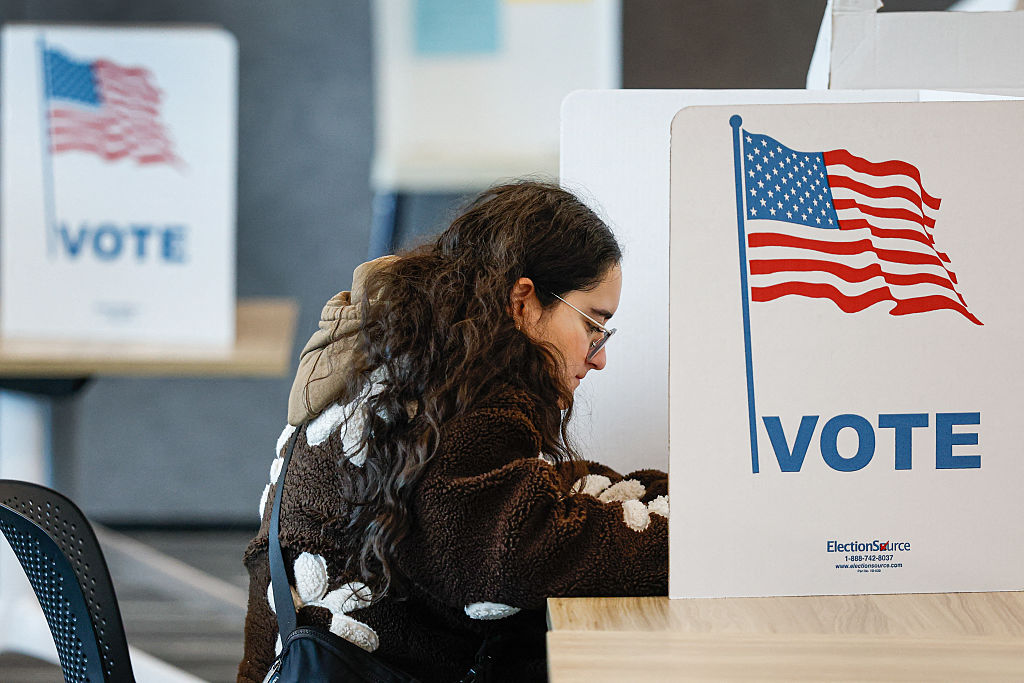
Democrats won a sweeping victory on Nov. 3, taking control of both houses of Congress and flipping at least four state executive mansions.
Midterm losses are not unusual for the party of the incumbent president, though the degree varies.
In the Senate, Democrats flipped long-held Republican seats in the South and Midwest.
Here’s what happened on Election Day, and what some experts think it signals for the next two years.
Blue Wave Hits
A Blue Wave struck the nation on Nov. 3 as Democrats picked up six seats to take back the Senate. The wave also washed over the House, where Democrats gained more than two dozen seats.
The first call of the night was in North Carolina, where former Gov. Roy Cooper, a Democrat, defeated former Republican National Committee Chairman Michael Whatley.
In South Carolina, Democrat Annie Andrews, a pediatrician, defeated incumbent Republican Sen. Darline Graham, who took the seat after her brother, the former Sen. Lindsey Graham (R-S.C.), died earlier this year.
Kansas pastor Adam Hamilton, a Democrat, defeated incumbent Republican Sen. Roger Marshall to become the state’s first Democrat elected to the Senate in 94 years.
Perhaps the biggest upset was in Texas, where Democratic state Rep. James Talarico defeated Republican Texas Attorney General Ken Paxton. Talarico will be the first Texas Democrat in the Senate since Lloyd Bentsen, who served between 1971 and 1993.
Democrat Sherrod Brown of Ohio will return to the Senate after defeating incumbent Sen. Jon Husted (R-Ohio) in a special election to fill the remaining two years of Vice President JD Vance’s Senate term. Brown represented Ohio in the Senate from 2007 to 2025.
Democratic state Rep. Josh Turek of Iowa defeated Republican Rep. Ashley Hinson to claim the seat to be vacated by Sen. Joni Ernst (R-Iowa). Ernst did not seek reelection. The last Iowa Democrat in the Senate was Tom Harkin, who retired in 2015.

In the House, Democrats flipped some seats in districts Trump had carried by double-digit margins in 2024.
Economy, Approval Rating Drove Outcome
Experts say two factors determine midterm election outcomes: the sitting president’s popularity and the economy. Both weighed strongly against the GOP.
Some 48 percent of registered voters said the cost of living was their top issue in this election, according to a Reuters/Ipsos poll. Gas prices were at a record high for an election day, averaging around $4.15 per gallon on Nov. 3, according to the American Automobile Association.
Exit polls confirmed that economic issues weighed heavily on voters’ minds. Eighty-seven percent of voters polled said they were concerned about what they pay at the pump. On inflation, 57 percent said it has caused “moderate hardship.”
The president’s job approval stood at 39 percent on Election Day, according to an average of polls compiled by RealClear Politics.
“The fundamentals are about as bad for Republicans as they could possibly be,” Ken Kollman, a political science professor at the University of Notre Dame, told The Epoch Times.

Yet the president himself was the largest factor in the electoral result, said Matthew Wilson, a professor of politics at Southern Methodist University.
“He is its primary author in general ways,” Wilson said, citing the president’s deportation policy and the Iran war, which have lacked widespread public support, and his selection of candidates such as Ken Paxton and Darline Graham, who were popular with the GOP base but held little appeal for general election voters.
Democrats Turn Out
Early voting for this election was the highest ever for a midterm election, reaching 61 million votes cast before Election Day. That was an increase of some 15 million early voters over the previous midterm election.
In states reporting early voters’ party registration, more Democrats (42 percent) voted early than Republicans (33 percent). That was consistent with 2022 levels.

That momentum appears to have continued on Election Day.
“Voter turnout was very high, and it was especially high on the Democratic side,” Wilson said. “Democrats have been champing at the bit to express their dissatisfaction with the Trump administration.”
Republicans did not match that enthusiasm, and many appear to have skipped the ballot box this year.
“There is clear apathy amongst GOP lifers,” Joseph Lopez, a Republican strategist from Texas, told The Epoch Times.
Trump Reacts
President Donald Trump was by turns defiant and pragmatic about his party’s defeat.
On his Truth Social account, the president was mostly defiant. He said that if he had been on the ballot, Republicans would have won.
Trump blamed Fox News for letting former New York City Democratic Mayor Bill de Blasio and other Democrats on the air regularly to talk down his administration.
He wrote that if defeated Republican Texas Gov. Greg Abbott “hadn’t become a RINO in the last six months of his Political Life, he wouldn’t have lost.”
The president also posted a photo of a red MAGA hat with the inscription changed to “VETO.”

When Trump went on Fox News to talk about the results, his presentation was slightly different. He said he accepted the race results and congratulated the Democrats on their victory. Yet he drew some lines.
Trump said that he could work with them on some issues but foresaw conflict in some others, including border security and transgender issues. He also said he would not make changes in his Cabinet based on the midterm results.
Regarding blame for the election results, Trump said, “It’s just a point in time. … It’s the way it is. There was a mood in the air, I guess.”

Kevin Kosar, a political scientist and senior fellow at the American Enterprise Institute, disagreed.
Kosar recounted the thorough drubbing that Republicans received at the federal and state levels.
He told The Epoch Times, “All this adds up to a massive rejection of President Donald Trump, who demanded that Americans should ‘pretend like I am on the ballot.’”
What’s Next for Republicans
Analysts predict gridlock in Washington based on the midterm results.
Trump will likely govern by executive order while the House launches investigations. Trump has indicated that he intends to use veto power.
“The post-mortem will be astounding,” Lopez said.

Beyond the loss of seats in Congress, the party will also have to deal with a loss of traction among some voters who warmed to Republicans in 2024, especially Hispanics.
“They made massive inroads with a population that is about 20 percent of the country,” Dusso said. “And it’s been completely squandered.”

And with this election over, the next presidential contest is just two years away.
Andrew Moran contributed to this report.
We had a problem loading this article. Please enable javascript or use a different browser. If the issue persists, please visit our help center.